%2520(350%2520x%2520150%2520px)%2520(90%2520x%252040%2520px)%2520(4).png%3Falt%3Dmedia%26token%3Dbed5580f-de12-4061-ac20-36c16b313f14&w=384&q=75)
Morning Cortisol Explained: Low vs High, Optimal Range & At-Home Testing in Dubai

TL;DR: Morning cortisol is your body's natural wake-up signal — it should peak shortly after you rise and taper steadily through the day. Too low and you may struggle to get going; too high and you may feel wired, anxious, and exhausted all at once. You can test it at home in Dubai with xlr8well — a DHA-licensed nurse collects your sample at the correct time, and results arrive in your private dashboard within 24–48 hours.
What Is Morning Cortisol?
Cortisol is a steroid hormone produced by the adrenal glands, which sit just above the kidneys. It is often labelled the "stress hormone," but that description only tells part of the story. Cortisol plays a central role in regulating metabolism, immune function, blood sugar, blood pressure, and the body's response to physical and psychological challenges. Nearly every cell in the body has cortisol receptors, which gives you a sense of how far its influence reaches.
In a healthy individual, cortisol follows a predictable daily rhythm called the diurnal cortisol curve. Levels begin rising in the early hours of the morning — even before the alarm goes off — and reach their highest point roughly 30 to 45 minutes after waking. This surge is sometimes called the Cortisol Awakening Response (CAR). It is thought to prime the brain and body for the demands of the day: mobilising energy stores, sharpening alertness, and supporting the immune system. After that morning peak, cortisol should decline gradually throughout the afternoon and evening, reaching its lowest point during the first half of the night to allow restorative sleep.
When that rhythm is disrupted — either blunted in the morning or abnormally elevated — the downstream effects can be wide-ranging and often misattributed to lifestyle issues or simply "being stressed."
What Low Morning Cortisol Can Mean
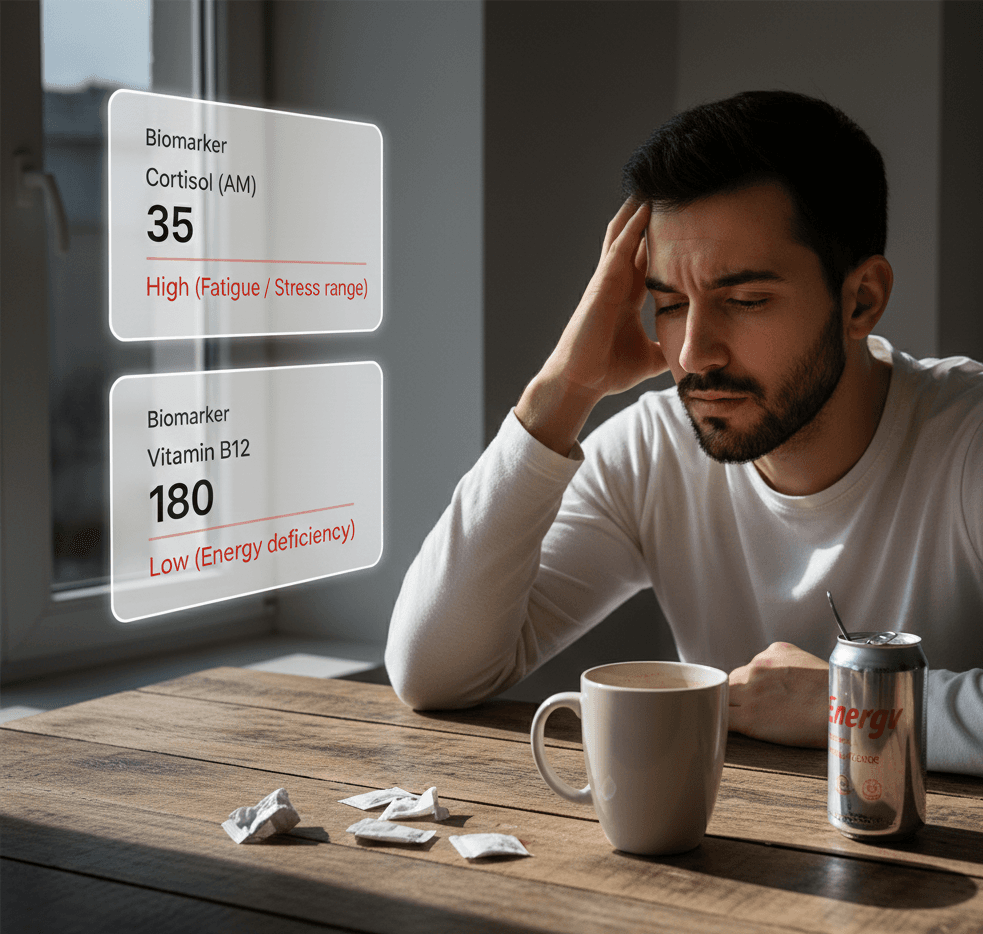
A blunted or low morning cortisol peak is sometimes associated with what many people describe as a "slow start" — persistent fatigue upon waking, difficulty thinking clearly before mid-morning, and a strong reliance on caffeine to feel functional. Over time, some people notice they feel most alert only in the evening, which can further disrupt sleep and compound the cycle.
Clinically, a significantly low morning cortisol — particularly when accompanied by symptoms such as dizziness on standing, unexplained weight loss, nausea, or extreme fatigue — warrants prompt medical evaluation, as it can in some cases indicate adrenal insufficiency. This is a serious condition that requires diagnosis and management by a licensed doctor. If you experience severe symptoms, please consult a physician without delay.
More commonly, a modestly blunted CAR appears in the context of:
- Prolonged psychological stress and burnout patterns
- Chronic sleep deprivation or poor sleep quality
- Overtraining without adequate recovery
- Certain nutritional deficiencies
- Some medications (always discuss your full medication list with your doctor)
It is important to note that a single cortisol reading below the population reference range does not, on its own, confirm adrenal insufficiency or any specific diagnosis. Interpretation should always be contextualised with symptoms and, where necessary, further investigation guided by a clinician.
What High Morning Cortisol Can Mean
An elevated morning cortisol is often associated with the familiar "wired but tired" feeling — a state in which the body is physiologically aroused yet the person feels mentally and physically drained. People with persistently high morning cortisol may notice:
- Difficulty falling asleep or staying asleep, particularly waking in the early hours
- Increased appetite, cravings for carbohydrates or sugary foods, and a tendency to store fat around the abdomen
- Heightened anxiety, irritability, or a sense of being "on edge"
- Elevated blood pressure or resting heart rate
- Impaired memory and concentration
Chronically elevated cortisol can, over time, have downstream effects on blood sugar regulation, immune function, bone density, and cardiovascular health. Again, context matters: cortisol naturally rises in response to acute illness, intense exercise, emotional stress, and even insufficient sleep the night before the test. A single elevated reading is a prompt for further conversation with a healthcare professional, not a definitive diagnosis.
When morning cortisol is markedly and persistently elevated alongside other symptoms — such as rapid weight gain, purple stretch marks, easy bruising, or changes in facial appearance — a doctor should evaluate for rarer conditions such as Cushing's syndrome.
Understanding the Optimal Range
Standard laboratory reference ranges for morning cortisol (typically drawn between 7 am and 9 am) are established by measuring a large population and identifying the middle 95%. This means the range describes what is statistically common, not necessarily what is physiologically optimal for you as an individual.
Functional and integrative medicine practitioners often look for cortisol to sit in the upper portion of the reference range at an 8 am draw — reflecting a robust cortisol awakening response — rather than simply "within range." A result at the very bottom of the reference interval, for instance, may still technically be "normal" on your report but could warrant further discussion if you are experiencing relevant symptoms.
Timing of the blood draw is critical. Cortisol begins to fall rapidly after the morning peak, so a sample taken at 10 am will look meaningfully different from one taken at 7:30 am. For this reason, morning cortisol testing is most informative when collected within 30–60 minutes of waking, before eating, before exercise, and — where possible — before significant emotional stress or caffeine.
Cortisol in the UAE Context
Dubai and the wider UAE present a particular set of lifestyle factors that may influence cortisol patterns. These include long working hours, frequent international travel and jet lag, high ambient temperatures (which can be a physiological stressor), Ramadan fasting schedules that shift the sleep-wake cycle, and — for many residents — the cumulative low-grade stress of relocation and adapting to a new environment. None of these are unique to the UAE, but they are common enough here to make cortisol an especially relevant biomarker for many residents seeking to understand their health more deeply.
How to Test Morning Cortisol at Home in Dubai
Accurate morning cortisol testing depends heavily on collecting the sample at the right time and under the right conditions — which is precisely where at-home testing has a practical advantage over visiting a clinic. There is no commute, no waiting room, and no opportunity for the sample to be drawn hours after waking.
With xlr8well, a DHA-licensed nurse visits your home at your chosen time, collects the blood sample at the clinically appropriate moment, and handles all transport to the laboratory. Results appear in your secure private dashboard within 24–48 hours, with flagged values explained in plain language. Most clients choose to test morning cortisol as part of a broader hormonal or metabolic panel rather than in isolation, which provides richer context for interpretation.
You can explore available panels on our at-home blood testing page, or build a custom test with exactly the markers relevant to your health goals.
Preparation Tips for an Accurate Result
- Schedule your sample collection within 30–60 minutes of waking — ideally between 7 am and 9 am
- Avoid eating, exercising, or consuming caffeine before the draw
- Try to ensure a reasonably representative night of sleep the evening before
- Inform your nurse of any medications, supplements, or hormonal therapies you are taking
- Your booking confirmation will include personalised preparation instructions
What Happens After Your Result
A morning cortisol result is most useful as a starting point rather than a final answer. If your result is outside the reference range, or within range but inconsistent with how you feel, a doctor review call can be added to any test. The xlr8well team automatically flags values outside optimal ranges and can help you understand whether follow-up testing — such as a saliva cortisol curve across the day, or additional hormone markers — may be appropriate. Any significant finding should be discussed with a licensed physician who can take your full clinical picture into account.