%2520(350%2520x%2520150%2520px)%2520(90%2520x%252040%2520px)%2520(4).png%3Falt%3Dmedia%26token%3Dbed5580f-de12-4061-ac20-36c16b313f14&w=384&q=75)
FSH Explained: Low vs High, Optimal Range & At-Home Testing in Dubai

TL;DR: FSH (follicle-stimulating hormone) is a key pituitary signal that drives ovarian follicle recruitment in women and supports sperm production in men. Understanding whether your FSH is low, high, or optimal — and interpreting it alongside related hormones — can reveal important information about reproductive health, hormonal balance, and overall wellbeing. You can test it at home in Dubai with xlr8well; a DHA-licensed nurse collects your sample and results arrive in your private dashboard within 24–48 hours.
What Is FSH?
Follicle-stimulating hormone (FSH) is produced and released by the anterior pituitary gland, a small but remarkably influential structure at the base of the brain. FSH belongs to the family of gonadotropins — hormones whose primary job is to communicate with the gonads (ovaries in women, testes in men) and regulate key aspects of reproduction and hormonal health.
The pituitary does not act alone. FSH release is itself controlled by gonadotropin-releasing hormone (GnRH) from the hypothalamus, and is modulated by feedback signals from the gonads — primarily oestrogen, progesterone, testosterone, and a protein called inhibin. This feedback loop means that FSH levels are a sensitive barometer of how well the reproductive axis is functioning at every stage of life.
FSH in Women
In women of reproductive age, FSH rises at the start of each menstrual cycle to stimulate the growth and maturation of ovarian follicles — the fluid-filled sacs that each contain an egg. As a follicle matures, it produces oestrogen, which feeds back to suppress FSH and ultimately trigger the LH surge that leads to ovulation. FSH levels therefore fluctuate naturally across the cycle, peaking in the early follicular phase (days 2–5) and shifting significantly around ovulation and menopause.
FSH in Men
In men, FSH acts on Sertoli cells within the testes to support spermatogenesis — the continuous production of sperm. It works in concert with LH and testosterone to maintain testicular function. Unlike in women, men's FSH levels do not follow a monthly cycle, but they are still subject to feedback from inhibin B (produced by Sertoli cells) and testosterone.
What Low FSH Means
A lower-than-expected FSH level suggests that the pituitary is not sending a strong enough signal to the gonads. This pattern, sometimes called hypogonadotropic hypogonadism when accompanied by low sex hormone levels, can have several causes:
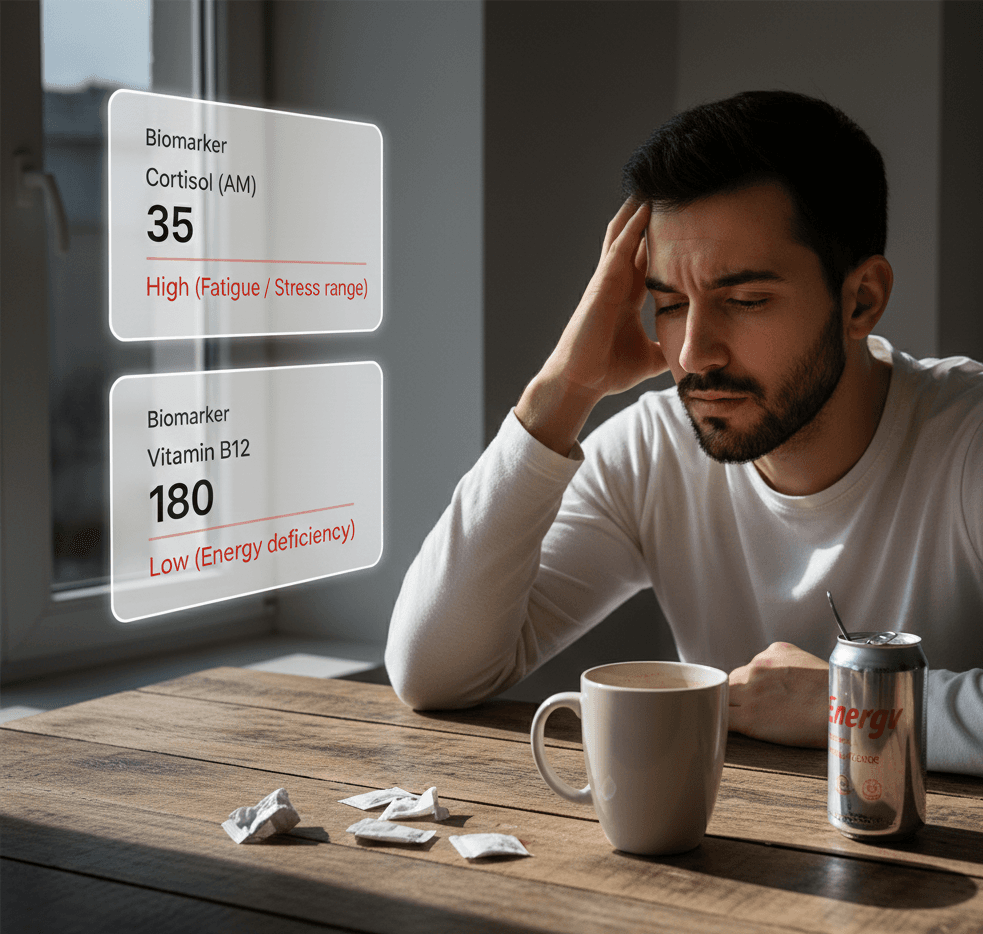
- Chronic stress and elevated cortisol — prolonged physiological or psychological stress can suppress the hypothalamic-pituitary-gonadal (HPG) axis, reducing GnRH pulsatility and downstream FSH output.
- Significant undereating or low body weight — energy deficit, as seen in restrictive eating or extreme endurance training, may down-regulate reproductive signalling as a survival mechanism.
- Exogenous hormones — use of anabolic steroids, testosterone replacement therapy, oral contraceptives, or certain other medications can suppress the natural FSH signal through negative feedback.
- Pituitary or hypothalamic dysfunction — less commonly, structural or functional issues with the pituitary or hypothalamus may reduce FSH output.
In women, chronically low FSH can be associated with irregular or absent periods and reduced fertility. In men, it may contribute to impaired sperm production. Low FSH should always be interpreted with a full hormonal picture and, where clinically relevant, discussed with a licensed doctor.
What High FSH Means
Elevated FSH is generally the pituitary's response to insufficient feedback from the gonads — it is working harder to stimulate structures that are becoming less responsive.
In Women
Rising FSH is one of the earliest and most reliable laboratory markers of declining ovarian reserve. As the pool of available follicles shrinks with age, the ovaries produce less inhibin B and oestrogen, weakening the feedback signal and allowing FSH to climb. Persistently elevated FSH — particularly when measured on days 2–5 of the cycle — may indicate:
- Diminished ovarian reserve (relevant for women exploring fertility options)
- Perimenopause — the transitional phase that can begin years before the final menstrual period
- Menopause — typically confirmed after 12 consecutive months without a period, with FSH levels often markedly elevated
- Primary ovarian insufficiency (POI) in younger women — a condition warranting specialist evaluation
In Men
High FSH in men often points to testicular underperformance — specifically, a reduced capacity of the testes to produce sperm or to generate adequate inhibin B feedback. This pattern can be associated with male factor infertility, a history of testicular injury or surgery, certain genetic conditions, or the effects of radiation or chemotherapy. Elevated FSH in men warrants further investigation with a healthcare professional.
The Optimal FSH Range: Why Context Is Everything
Reference ranges for FSH vary between laboratories, assay methods, and — critically — the phase of the menstrual cycle in women and stage of life for both sexes. Typical laboratory reference ranges in adults might look broadly like this:
- Women (follicular phase): approximately 3–10 IU/L
- Women (perimenopausal/menopausal): significantly higher, sometimes above 25–40 IU/L
- Men: approximately 1.5–12 IU/L
However, these are population-derived reference intervals, not personalised health targets. A result described as "in range" on a standard report may still represent a meaningful trend when tracked over time or interpreted alongside related markers. FSH should never be read in isolation. Clinically meaningful interpretation requires pairing it with:
- LH (luteinising hormone) — the ratio and pattern of FSH and LH together provide much richer information than either alone
- Oestradiol (E2) in women — a simultaneous high oestradiol can artificially suppress FSH on a given day, masking a true elevation
- Testosterone and inhibin B in men
- AMH (anti-Müllerian hormone) in women as an additional marker of ovarian reserve
- Clinical history, symptoms, and age
For this reason, FSH is most informative when tested as part of a broader hormonal panel rather than as a single standalone marker.
Who Should Consider Testing FSH?
FSH testing may be worth considering for a range of individuals, including:
- Women in their late 30s or 40s who are curious about their ovarian reserve or noticing cycle changes
- Anyone experiencing symptoms of perimenopause or early menopause — irregular periods, hot flushes, sleep disruption, or mood changes
- Couples who have been trying to conceive without success
- Men with concerns about fertility or testicular function
- Individuals on or considering hormonal therapies who want a baseline
- Those tracking overall hormonal health as part of a proactive wellness approach
As always, a blood test provides data — interpreting what that data means for your specific circumstances is a conversation best had with a qualified healthcare professional.
Preparing for Your FSH Test
FSH does not require fasting in the way that glucose or lipid markers do. However, timing matters:
- Women with regular cycles: FSH is most informative when drawn on days 2, 3, or 4 of the menstrual cycle (day 1 being the first day of full flow). Testing at other cycle points is still possible but harder to interpret without knowing where you are in your cycle.
- Women without regular cycles or post-menopausal: testing can be done on any day.
- Men: no specific timing is required.
Your xlr8well booking confirmation will include precise preparation guidance tailored to your test panel. If you are unsure about timing, contact the team before booking.
How to Test FSH at Home in Dubai
Visiting a clinic to have blood drawn is not always convenient — particularly given Dubai's climate and the demands of a busy schedule. xlr8well offers at-home blood testing across Dubai and the UAE, where a DHA-licensed nurse visits your home, office, or hotel at a time that suits you, collects your sample, and dispatches it to an accredited laboratory. Results appear in your private xlr8well dashboard within 24–48 hours, with flagged values explained in plain language.
Most clients choose to test FSH as part of a broader hormonal or fertility-related panel, rather than as a single marker. You can explore ready-made panels on our at-home blood testing page, or build a custom test with exactly the markers relevant to your goals. A doctor review call can be added to any test for personalised guidance on your results.