%2520(350%2520x%2520150%2520px)%2520(90%2520x%252040%2520px)%2520(4).png%3Falt%3Dmedia%26token%3Dbed5580f-de12-4061-ac20-36c16b313f14&w=384&q=75)
Masking: Why Your Child Holds It Together at School and Falls Apart at Home
What Is Masking — and Why Does It Matter?
Masking, sometimes called "camouflaging," describes the conscious or unconscious effort many autistic children make to suppress, hide, or imitate neurotypical behaviours in order to fit into social environments. In practice, this might look like forcing eye contact, scripting conversations in advance, suppressing the urge to stim, mirroring classmates' body language, or simply working very hard to appear calm when everything inside feels overwhelming.
To outside observers — teachers, other parents, even extended family — a child who masks successfully can appear to be coping brilliantly. They follow instructions, they sit still, they participate. The hidden reality is that every single one of those performances costs enormous cognitive and emotional energy. By the time the school day ends, the reserve is empty.
Understanding masking is one of the most important shifts a parent can make, because it reframes the after-school experience entirely. The child who screams, cries, shuts down, or "acts out" the moment they walk through your door is not being manipulative. They are, in the most literal sense, finally allowed to stop performing — and the accumulated tension of the day releases in the place where they feel safest: with you.
The "Coke Bottle Effect" — How Pressure Builds Unseen
A useful way to picture masking is to imagine a fizzy drink bottle shaken continuously throughout the school day. The pressure inside builds and builds, yet the outside stays sealed — nothing visible escapes. The moment the cap is twisted off (the school gates, your front door), everything erupts.
This is not a failure of the child's character, and it is emphatically not a failure of your parenting. In fact, the emotional safety of your home is precisely what makes the release possible. Children who have no safe place to decompress often internalise that pressure for longer, which carries its own significant risks.
In a Dubai school context, the demands can be especially layered. Many children are navigating a second or third language of instruction, large class sizes, sensory environments that are heavily air-conditioned yet acoustically loud, and the unwritten social rules of a highly diverse peer group. Each of these adds to the shaking of the bottle before the school run home.
What Chronic Masking Can Do Over Time
Occasional masking is something most children do to some degree. For autistic children, however, it can become a near-constant state across the entire school day, every day. Over weeks and months, some children and young people may experience:
- Autistic burnout — a state of profound exhaustion, reduced functioning, and withdrawal that goes well beyond a bad week. Recovery can take months.
- Heightened anxiety — the vigilance required to monitor and adjust one's behaviour constantly is closely linked to elevated anxiety over time.
- Erosion of self-identity — children who mask heavily may struggle to know who they actually are, what they genuinely enjoy, or how they really feel, because so much energy goes into being someone else.
- Delayed identification of support needs — because the child appears to cope at school, parents and teachers may not realise how much difficulty is being carried, sometimes delaying access to helpful support.
None of this is inevitable, and awareness is the first and most powerful step. If you have concerns about your child's wellbeing, consulting a developmental paediatrician, psychologist, or allied health professional is always worthwhile — a diagnosis is not required to begin exploring support.
Recognising Masking in Your Child
Masking looks different in every child. Some indicators that a child may be suppressing autistic traits at school include:
- Appearing fine or even cheerful at school pick-up, then melting down within minutes of arriving home
- Exhaustion or sleep difficulties that seem disproportionate to physical activity
- Reporting that school is "fine" or "okay" while showing clear signs of distress at home
- Copying other children's speech patterns, jokes, or mannerisms in ways that feel rehearsed
- Suppressing stimming behaviours visibly — only to stim intensely once at home
- A marked difference in behaviour between school reports and what you observe at home
This gap between the "school self" and the "home self" is one of the most consistent signs that masking is occurring, and it deserves to be taken seriously rather than dismissed as children "just being tired."
The Landing Pad: Practical Decompression After School
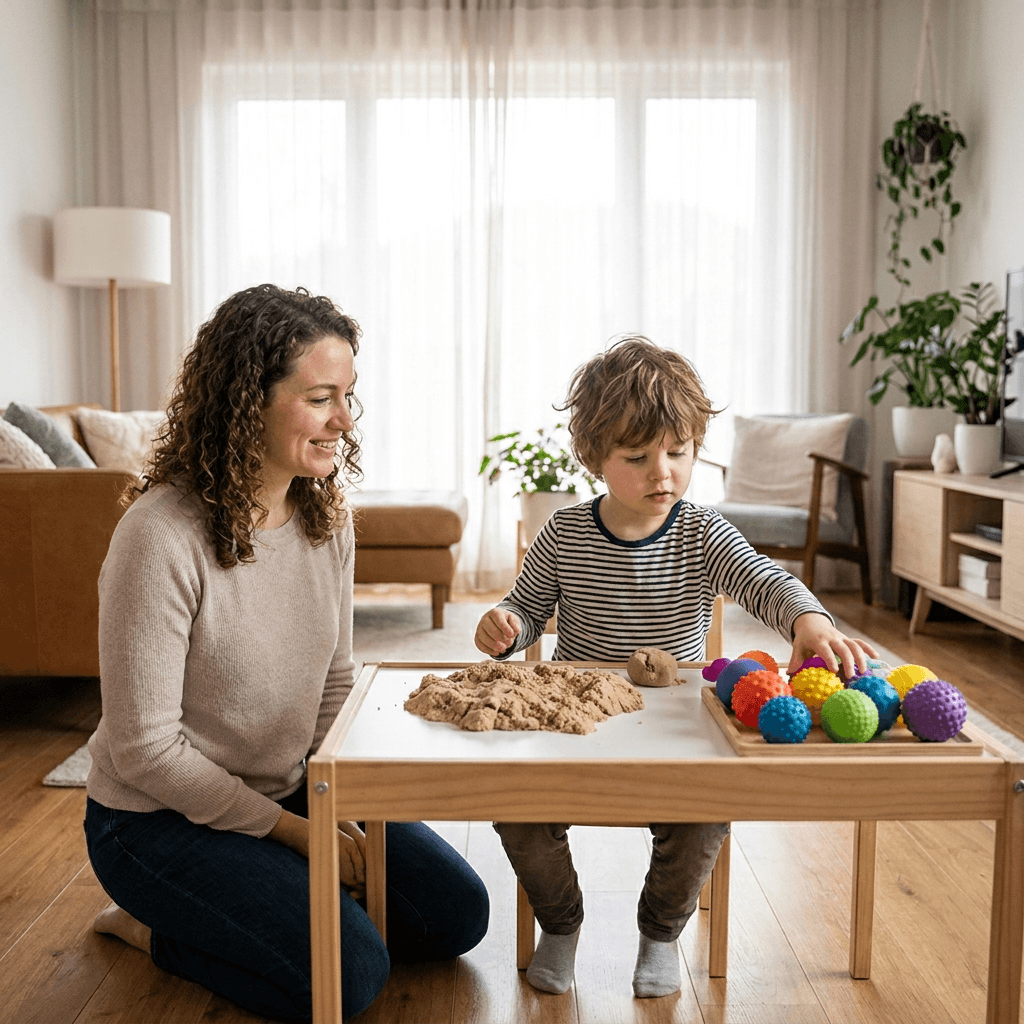
The single most impactful adjustment many families make is building what is sometimes called a "landing pad" — a structured, low-demand period immediately after school that allows the nervous system to transition from performance mode to rest mode.
A good landing pad typically includes:
- Time: At least 20–30 minutes of genuinely unstructured, low-demand time — no questions, no tasks, no debriefs about the school day.
- Sensory comfort: A familiar snack, dimmer lighting if possible, reduced noise. Many children find it helpful to change out of school uniform immediately, which physically signals the transition.
- Repetitive or preferred activity: Whatever the child finds regulating — a specific video, a tactile toy, a short walk, music they know. Repetition is regulating, not a problem to solve.
- Zero social demands: This is not the moment for "how was your day?" That question, however warmly meant, is another performance request. Connection can come later, once the system has settled.
Families who implement a consistent landing pad often report that evenings become noticeably more manageable. The meltdown that was arriving at 5pm begins to reduce in intensity or frequency — not because the child has changed, but because their nervous system has been given the space it needs.
Talking to Schools: Advocating for a Lower-Mask Environment
Longer-term, the goal is not simply to help children recover from masking at home — it is to reduce the need to mask in the first place. This involves collaboration with school staff. Practical conversations might include:
- Requesting a quiet space or "break card" system that allows your child to step away before overload escalates
- Asking about sensory accommodations — seating, lighting, noise management
- Exploring whether there is flexibility around social participation in ways that feel genuinely optional
- Sharing information about masking with class teachers who may not be familiar with the concept
In the UAE, many schools have learning support departments and are increasingly familiar with sensory and neurodevelopmental needs. Coming to those conversations with clear, specific requests — rather than general concerns — tends to be most effective.
Getting Support in Dubai
If you recognise masking in your child and would like professional guidance, support does not have to wait for a formal diagnosis. Occupational therapists can work on sensory regulation and decompression strategies. Speech and language therapists can support communication confidence in ways that reduce the social effort of school. Applied Behaviour Analysis (ABA) practitioners and psychologists can work with the whole family on understanding and responding to autistic needs.
xlr8well's multidisciplinary team delivers speech, ABA, occupational, and physical therapy at home anywhere in Dubai, as well as at Bloom Autism Center (Office 702, Yes Business Tower, Al Barsha 1, Dubai). Every journey starts with a free, judgement-free consultation on WhatsApp — and a diagnosis is never required to begin. Explore our autism therapy services.
This article is general information for parents and caregivers, not a clinical diagnosis or a substitute for professional assessment of your child.