%2520(350%2520x%2520150%2520px)%2520(90%2520x%252040%2520px)%2520(4).png%3Falt%3Dmedia%26token%3Dbed5580f-de12-4061-ac20-36c16b313f14&w=384&q=75)
At-Home Blood Tests in Dubai: Panels, Preparation, and How to Read Your Results
Medically reviewed by Dr. Sohaib Ali, Medical Director, DHA licence 10441205-001.
An at-home blood test in Dubai works exactly like a clinic blood test, minus the clinic: a qualified nurse comes to you, draws your samples, and sends them to an accredited laboratory — and your results come back with a plain-language explanation rather than a PDF to decode alone. This guide covers how it works, how to prepare (including fasting), which panels make sense, how accurate home draws are, and how to actually read the numbers you get back.
What is an at-home blood test?
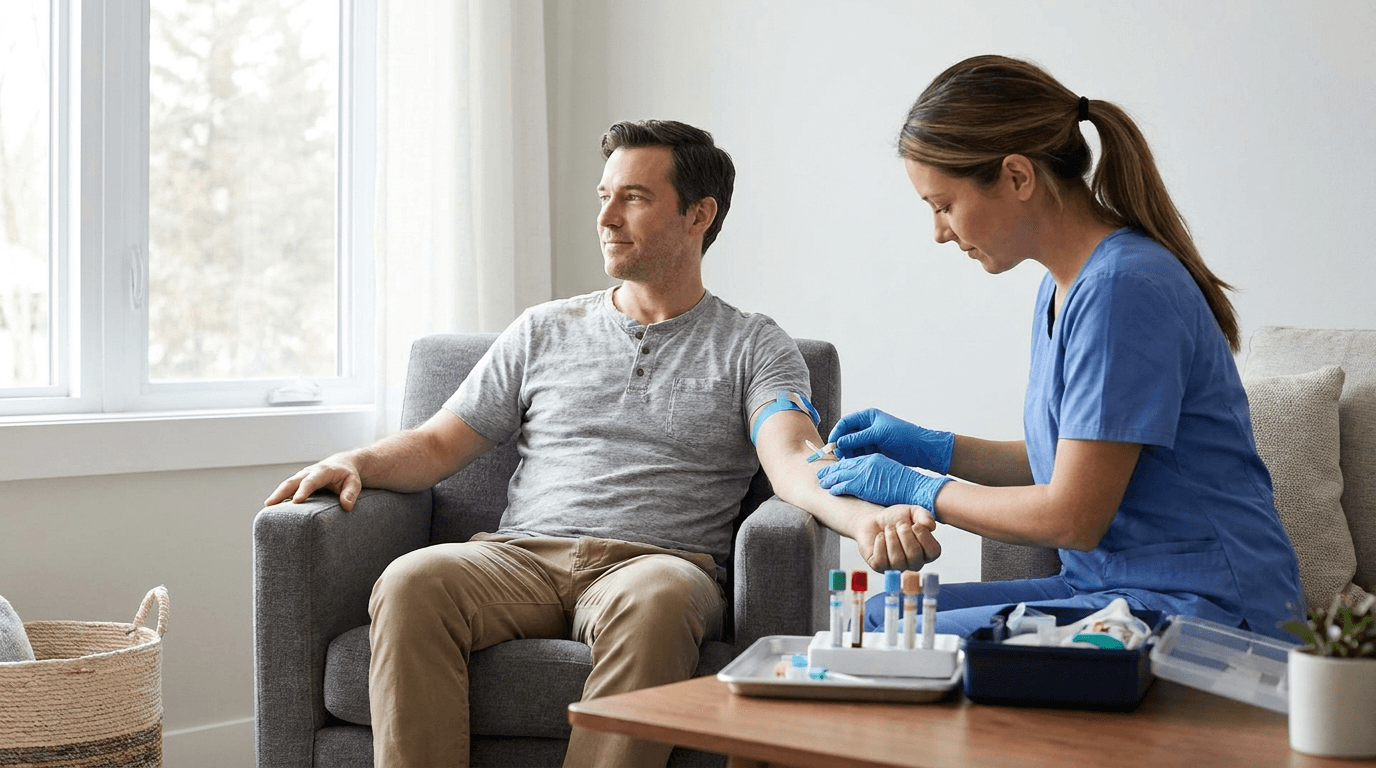
It's mobile phlebotomy: instead of travelling to a lab, a trained nurse visits your home, hotel, or office, takes your blood using standard sterile procedures, and the samples are processed at an accredited laboratory. You get the same analysis you'd get from a clinic draw, with the convenience of never leaving home — which matters for busy parents, anyone managing an elderly relative, or people who simply find clinic visits hard to fit in.
The clinical standard doesn't change with the location. What changes is the experience around it: booking, the visit itself, and — the part most providers ignore — what happens to your results afterwards.
How at-home blood testing works, step by step
- Book and choose a panel. Your coordinator helps you pick the right test for your goals (more on panels below).
- The nurse visit. A qualified nurse arrives at your chosen time and location and draws your samples — usually a few minutes.
- Accredited lab processing. Samples go to an accredited laboratory for analysis, the same as a clinic draw.
- Results, explained. Your results arrive in one place with a plain-language note and a clear next step — not just raw numbers.
- Follow-up, handled. If a result needs action, your coordinator arranges the next step rather than leaving you to chase it.
You can see the full service on our at-home blood tests in Dubai page.
How to prepare for a blood test
Preparation depends on the test, and getting it wrong is the most common reason results come back unusable. The essentials:
- Fasting: how many hours? Many tests — including glucose and lipid (cholesterol) panels — require fasting, typically 8 to 12 hours. Your coordinator will tell you whether your specific panel needs it.
- Can you drink water while fasting? Yes. Plain water is fine and actually helps — being hydrated makes the draw easier. Avoid tea, coffee, juice, and food.
- Medication. Don't stop prescribed medication for a blood test unless a doctor tells you to. Some medicines can affect certain results, so tell your clinician what you take and they'll advise.
- Thyroid tests. Most routine thyroid panels don't strictly require fasting, though timing and consistency can matter — follow your clinician's instruction.
- General: avoid alcohol the day before, and avoid intense exercise right before the draw, as both can skew some markers.
Which blood panels can you do at home?
Common options, all available through a home visit:
- General health / full blood count (CBC): a broad screen of red cells, white cells, and platelets.
- Metabolic and organ panels: glucose, kidney (including eGFR), and liver markers.
- Lipid profile: cholesterol and triglycerides (usually fasting).
- Hormone panels: thyroid, and sex or stress hormones where relevant.
- Vitamins and minerals: vitamin D, B12, iron studies.
- Preventive / longevity baselines: broader biomarker panels used to establish a baseline and track trends over time.
The right panel isn't a guess — your coordinator and clinician match it to your goals, age, and history.
How to read a blood test: a plain-language guide
You don't need to interpret your own results — that's a clinician's job, and at XLR8Well your coordinator translates them for you. But understanding the common markers helps you ask better questions. Here's what some of the most-searched ones mean:
- CRP (C-reactive protein): a marker of inflammation; raised levels can indicate infection or inflammation somewhere in the body.
- Hemoglobin: the oxygen-carrying protein in red blood cells; low levels can point to anaemia.
- MCV (mean corpuscular volume): the average size of your red blood cells; helps identify the type of anaemia.
- Hematocrit / PCV: the proportion of your blood made up of red blood cells.
- eGFR (estimated glomerular filtration rate): an estimate of how well your kidneys filter blood; lower values can signal reduced kidney function.
- Eosinophils: a type of white blood cell; higher levels can relate to allergies, asthma, or certain infections.
Two things to remember: reference ranges vary slightly between labs, and a single value rarely tells the whole story — what matters is the full picture, in context, interpreted by a clinician. A number outside the "normal" range isn't automatically a problem, and a normal number doesn't always rule one out.
Are at-home blood tests accurate?
Yes. Accuracy depends on two things — a correct draw and a quality lab — and both are the same at home as in a clinic. Samples are collected by a qualified nurse using standard procedures and analysed at an accredited laboratory, so a home draw is as reliable as a clinic one. The convenience doesn't cost you accuracy.
What a blood test can — and can't — tell you
Blood tests are powerful screening and monitoring tools: they can flag inflammation, anaemia, organ-function changes, hormone imbalances, and nutritional deficiencies, and they're how you track health trends over time. They are not a single test for "everything," and some conditions need imaging or specialist tests rather than bloodwork. The right approach is a panel chosen for your situation, read in context — which is exactly the conversation a clinician should have with you, not a number you interpret alone at midnight.
Results, explained — not just delivered
This is the part that's usually missing. With most one-off testing, you get a PDF and you're on your own. The XLR8Well model is the opposite: results land in one place with a plain-language note and a next step, and if something needs following up — a repeat test, a doctor's visit, a referral — your coordinator books it. For a family, that means one person tracking everyone's results over time, so nothing falls through the cracks. If a result points to something clinical, our doctor-on-call and home visit service handles the next step at home.
How much does an at-home blood test cost in Dubai?
Cost depends on the panel. Members receive included diagnostic panels each year as part of their plan, and additional or one-off panels are quoted on booking. As with most diagnostics, the test itself is the inexpensive part; the value is in choosing the right panel and acting on the result.
Frequently asked questions
Can I get a blood test at home in Dubai?
Yes. A qualified nurse comes to your home, hotel, or office anywhere in Dubai, draws your samples, and they're processed at an accredited lab. You never need to visit a clinic.
How many hours do I need to fast for a blood test?
Many tests — including glucose and lipid panels — need 8–12 hours of fasting. Others don't. Your coordinator will tell you whether your specific panel requires it.
Can I drink water before a fasting blood test?
Yes. Plain water is fine and helps make the draw easier — but avoid food, tea, coffee, and juice during the fasting window.
Can I take my medication before a fasting blood test?
Don't stop prescribed medication unless a doctor tells you to. Some medicines affect certain results, so tell your clinician what you take and follow their advice.
Do I need to fast for a thyroid blood test?
Most routine thyroid panels don't strictly require fasting, though timing and consistency can matter. Follow your clinician's instruction.
How do I read my blood test results?
You don't have to — a clinician interprets them, and your coordinator explains them in plain language with a next step. Markers like CRP (inflammation), hemoglobin (anaemia), and eGFR (kidney function) only mean something in context and across the full panel.
Are at-home blood tests accurate?
Yes. Samples are collected by a qualified nurse using standard procedures and analysed at an accredited lab, so accuracy matches a clinic draw.
How much does an at-home blood test cost in Dubai?
It depends on the panel. Members get included panels each year; one-off panels are quoted on booking.
References
Authoritative sources for the clinical points in this guide. Reference ranges and individual advice vary; always follow your own clinician.
- MedlinePlus (NIH/NLM) — Fasting for a Blood Test — on fasting duration and drinking water before a test.
- Cleveland Clinic — Fasting for Blood Work — on glucose/lipid fasting windows and medication guidance.
- National Kidney Foundation — Estimated Glomerular Filtration Rate (eGFR) — on interpreting kidney-function results.
Want a clear read of your family's health to start? Book a free family health review — a clinician-informed baseline, with every result explained.