%2520(350%2520x%2520150%2520px)%2520(90%2520x%252040%2520px)%2520(4).png%3Falt%3Dmedia%26token%3Dbed5580f-de12-4061-ac20-36c16b313f14&w=384&q=75)
IV Drip Therapy in Dubai: What It Is, What It Does, and How At-Home Drips Work

Medically reviewed by Dr. Sohaib Ali, Medical Director, DHA licence 10441205-001.
IV drip therapy delivers fluids, vitamins, and other nutrients directly into your bloodstream through a vein, so they're absorbed immediately instead of passing through your digestive system first. An IV drip in Dubai is used for everything from rehydration and recovery to vitamin and immunity support — and, increasingly, IV therapy can be done at home rather than in a clinic. This guide explains what IV therapy actually is, what the evidence does and doesn't support, how to stay safe, and how to decide whether it's right for you.
What is an IV drip?
An IV ("intravenous") drip is a small, sterile line placed into a vein — usually in the arm — through which a measured solution flows slowly into your bloodstream. Because it bypasses the gut, the contents are delivered at close to full availability and take effect quickly. A standard session takes roughly 30 to 60 minutes once a clinician has done a brief pre-treatment check (NAD+ infusions take longer — see below).
The solution itself varies. At its simplest it's saline for hydration; more complex blends add vitamins (commonly B-complex, vitamin C), minerals, amino acids, or antioxidants chosen for a specific goal. The key point: an IV drip is a clinical procedure, not a consumer product, which is why it should be set up and supervised by a licensed clinician.
Types of IV drips available in Dubai
Most providers in Dubai organise their menu into a few broad categories:
- Hydration and recovery drips — saline-based fluids, sometimes with electrolytes, used to rehydrate after illness, travel, heat, or intense exercise.
- Vitamin and immunity blends — often called a vitamin drip in Dubai, these are formulations built around vitamin C, B vitamins, and minerals, marketed for general wellbeing and immune support.
- Energy and wellbeing drips — combinations aimed at fatigue and general vitality.
- NAD+ therapy — a distinct, higher-interest option covered in its own section below.
Which one suits you isn't a menu choice to make alone — a clinician should match the formulation to your health, goals, and any conditions or medications, and decline anything that isn't appropriate for you.
What does an IV drip do, and does it work?
This is where honesty matters more than marketing. The evidence falls into two clear groups:
Where IV therapy is well established: for genuine clinical dehydration, diagnosed nutrient deficiencies, or situations where someone can't absorb nutrients normally, IV delivery is a recognised, effective medical treatment — under medical supervision.
Where the evidence is limited: for routine "wellness" drips in healthy, well-nourished people, high-quality clinical evidence of lasting benefit is limited. Much of the perceived benefit of a hydration or vitamin drip comes from correcting mild dehydration or simply the rest involved — effects that are real but often modest and short-lived. Any reputable provider should set expectations accordingly rather than promise outcomes.
That balance is the responsible position, and it's the one we take: IV therapy can be a genuinely useful tool for the right person at the right time, decided by a clinician — not a cure-all.
What is NAD+ IV therapy?
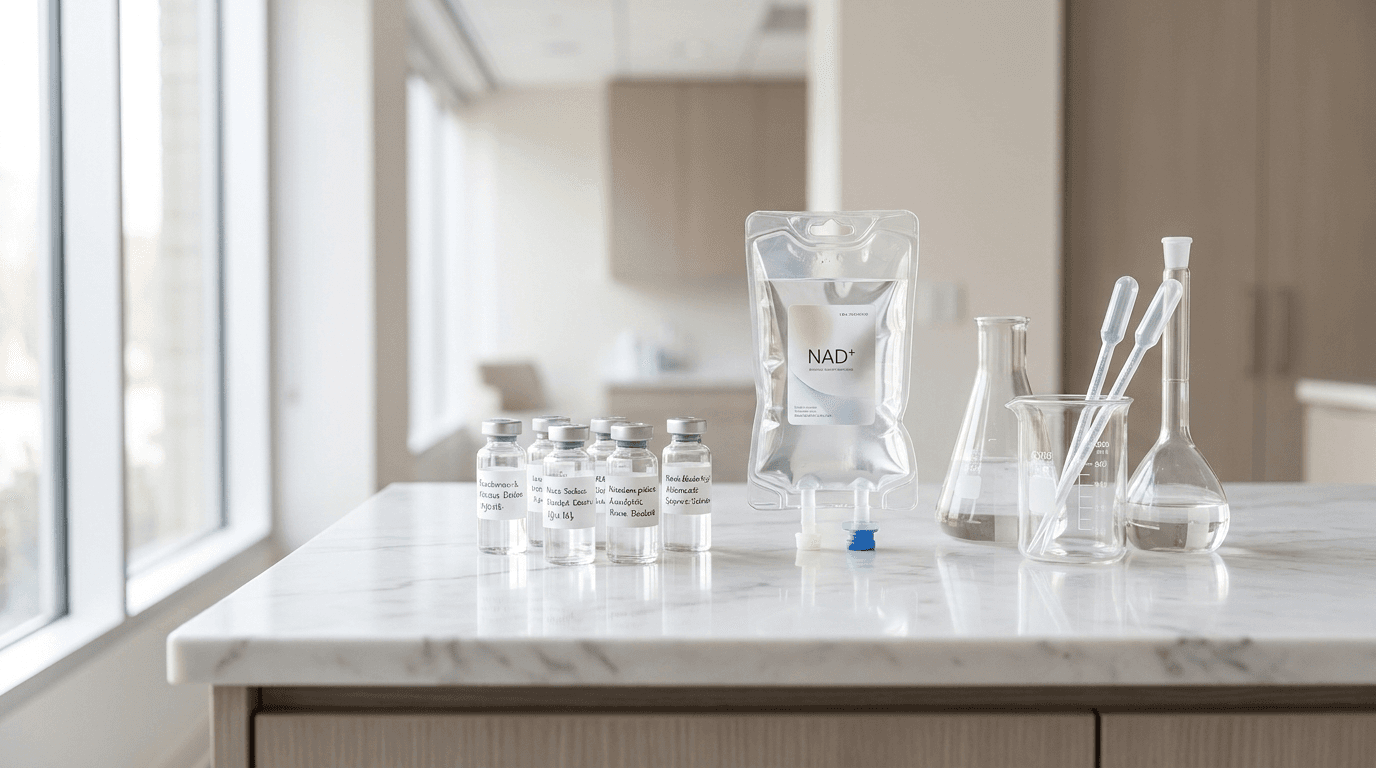
NAD+ (nicotinamide adenine dinucleotide) is a coenzyme your cells use to produce energy and support repair processes, and levels naturally decline with age. NAD+ IV therapy delivers it directly into the bloodstream, and interest has grown around its potential role in energy, cellular health, and longevity programmes.
Unlike a standard hydration or vitamin drip, NAD+ is infused slowly — typically over two to four hours or more — because delivering it too quickly commonly causes nausea or chest tightness. That slower pace is normal and expected, and a good reason to have it done under supervision rather than rushed.
The honest status: research into NAD+ is active and promising in some areas, but still developing, and robust long-term human evidence is limited. If you're considering it, treat it as part of a supervised, measured programme — assessed, monitored, and reviewed by a clinician — rather than a standalone fix. (See our peptide therapy and longevity approach for how this fits a broader plan.)
Is IV drip therapy safe?
IV therapy is generally safe when it's administered by a licensed clinician after a proper assessment. The risks are real but manageable, and almost all of them trace back to who administers it and whether you were assessed first:
- Minor, common effects: bruising, vein irritation, or discomfort at the insertion site.
- Less common: infection at the site, or a reaction to an ingredient.
- More serious, and the reason assessment matters: people with kidney or heart conditions can be harmed by fluid and electrolyte loads that are fine for others, and some ingredients interact with medications or existing conditions.
This is precisely why IV therapy should never be self-administered or given without a clinical check. At XLR8Well, every drip is administered by DHA-licensed clinical staff who review your health information first — and won't proceed if it isn't appropriate for you.
IV drip in a clinic vs at home in Dubai
For many people the practical question isn't whether but where. Here's the honest comparison:
| In a clinic | At home (XLR8Well) | |
|---|---|---|
| Clinical standard | Licensed clinician | Same — DHA-licensed clinician |
| Travel & waiting | You travel, you wait | Clinician comes to you |
| Comfort | Clinical setting | Rest at home, hotel, or office |
| Aftercare | Usually ends at the door | Coordinator tracks and follows up |
| Timing | Clinic hours | Often same-day, at your slot |
The procedure is identical; what changes at home is the convenience and the continuity — a named coordinator who arranges the visit, keeps your records in one place, and follows up afterwards. You can read the full service details on our IV drips at home in Dubai page.
How much does an IV drip cost in Dubai?
Pricing depends on the formulation and whether the visit is at home. Rather than quote a single figure that goes stale, the model worth understanding is this: XLR8Well members receive IV therapy at member rates as part of their concierge plan, and one-off visits are quoted on booking.
A note on insurance: IV "wellness" drips are typically not covered by health insurance in the UAE, since insurance is generally designed for treating illness rather than elective wellness services. Medically necessary IV treatment, ordered by a doctor, is a different matter and depends on your policy.
How to decide if IV therapy is right for you
A simple, honest filter:
- Worth a conversation if you're recovering from illness or dehydration, have a diagnosed deficiency, or want a clinician's view on whether a specific drip fits a wider health plan.
- Manage expectations if you're a healthy, well-nourished adult expecting a dramatic or lasting effect from a routine vitamin drip — the realistic benefit is usually modest.
- Always start with a clinical assessment, and choose a provider who administers with licensed clinicians and is honest about the evidence.
The right first step isn't booking a drip — it's a proper read of your health. That's what our free family health review is for: a clinician-informed picture first, then a recommendation only if it genuinely fits.
Frequently asked questions
What is an IV drip?
An IV drip is a sterile line placed into a vein that delivers fluids and nutrients directly into your bloodstream, bypassing digestion for immediate absorption. A typical session takes 30–60 minutes after a brief clinical check.
What's in an IV drip?
It depends on the goal. The base is usually saline for hydration; blends may add vitamins (such as B-complex or vitamin C), minerals, amino acids, or antioxidants. A clinician selects the formulation for you.
Do IV drips work?
For genuine dehydration or a diagnosed deficiency, IV therapy is an effective, established medical treatment. For routine wellness drips in healthy people, high-quality evidence of lasting benefit is limited and effects are usually modest — a reputable provider will say so.
Is IV vitamin therapy safe?
It's generally safe when administered by a licensed clinician after an assessment. Risks include site bruising or infection and, importantly, fluid or ingredient effects that can harm people with certain kidney, heart, or other conditions — which is why a pre-treatment check is essential.
What is NAD+ IV therapy?
NAD+ is a coenzyme involved in cellular energy and repair that declines with age. NAD+ IV therapy delivers it intravenously; interest is growing for energy and longevity, though long-term human evidence is still developing. It's best done within a supervised programme.
How long does an IV drip take?
Most drips run 30–60 minutes once the clinician has completed the short pre-treatment check, and you can rest throughout. NAD+ infusions are the exception — they're given slowly over several hours.
How often should you have IV therapy?
There's no universal answer — it depends on the reason and your health. Frequency should be guided by a clinician rather than a fixed schedule, and routine drips are not something most healthy people need regularly.
Can I get an IV drip at home in Dubai?
Yes. XLR8Well brings IV therapy to your home anywhere in Dubai, often the same day. A licensed clinician arrives with everything needed, and your coordinator handles booking and follow-up.
Does insurance cover IV drips in the UAE?
Elective wellness drips are usually not covered, as insurance generally targets treating illness. Medically necessary IV treatment ordered by a doctor may be covered depending on your policy.
References
Authoritative sources for the clinical points in this guide. Reference ranges and individual advice vary; always follow your own clinician.
- Merck Manual (Professional) — Intravenous Vitamin Therapy (Myers’ Cocktail) — on what IV vitamin therapy is and its clinical use.
- CADTH / NCBI Bookshelf — Intravenous Multivitamin Therapy: Clinical Effectiveness and Guidelines — on the limited evidence for routine wellness drips.
- Clinical Evidence for Targeting NAD Therapeutically (PMC) — on the developing state of NAD+ evidence.
Considering IV therapy as part of a wider health plan? Book a free family health review — a clinician-informed picture first, a recommendation only if it fits.