%2520(350%2520x%2520150%2520px)%2520(90%2520x%252040%2520px)%2520(4).png%3Falt%3Dmedia%26token%3Dbed5580f-de12-4061-ac20-36c16b313f14&w=384&q=75)
15 Months Milestones: What to Expect, Red Flags & How to Help
At a glance: At 15 months, most toddlers are saying a handful of meaningful words, taking confident first steps, and delighting in copying the people around them. This article explains what developmental science tells us about this age, which signs are worth watching, and what parents in the UAE can do to support their child's growth — or seek help early if needed.
Why 15 months is a notable milestone age
The period between 12 and 18 months is one of the most rapid in a child's entire life. Language, movement, social connection, and thinking skills are all accelerating at the same time. Paediatricians and developmental therapists pay particular attention to the 15-month mark because it sits at the midpoint of this window — early enough that any concerns can be addressed while the brain's plasticity is at its peak, and late enough that genuinely meaningful patterns have had time to emerge.
It is also worth understanding what milestone checklists actually are: they describe what most children can do at a given age, based on large population studies. They are not pass/fail tests. A single skill arriving a few weeks later than the average is rarely significant. What matters is whether a child is broadly progressing across several areas of development.
What most children do at 15 months
The following reflects the general developmental range for this age. Individual children vary, and bilingual or multilingual environments — very common in the UAE — can shift the timing of some language milestones without indicating any difficulty.
- Language: Uses 3–10 words meaningfully (not just sounds, but words that refer to specific people, objects, or actions). May combine a word with a gesture, such as pointing and saying "dog".
- Understanding: Follows simple one-step instructions, particularly when supported by a gesture — for example, "bring me the ball" while pointing at it.
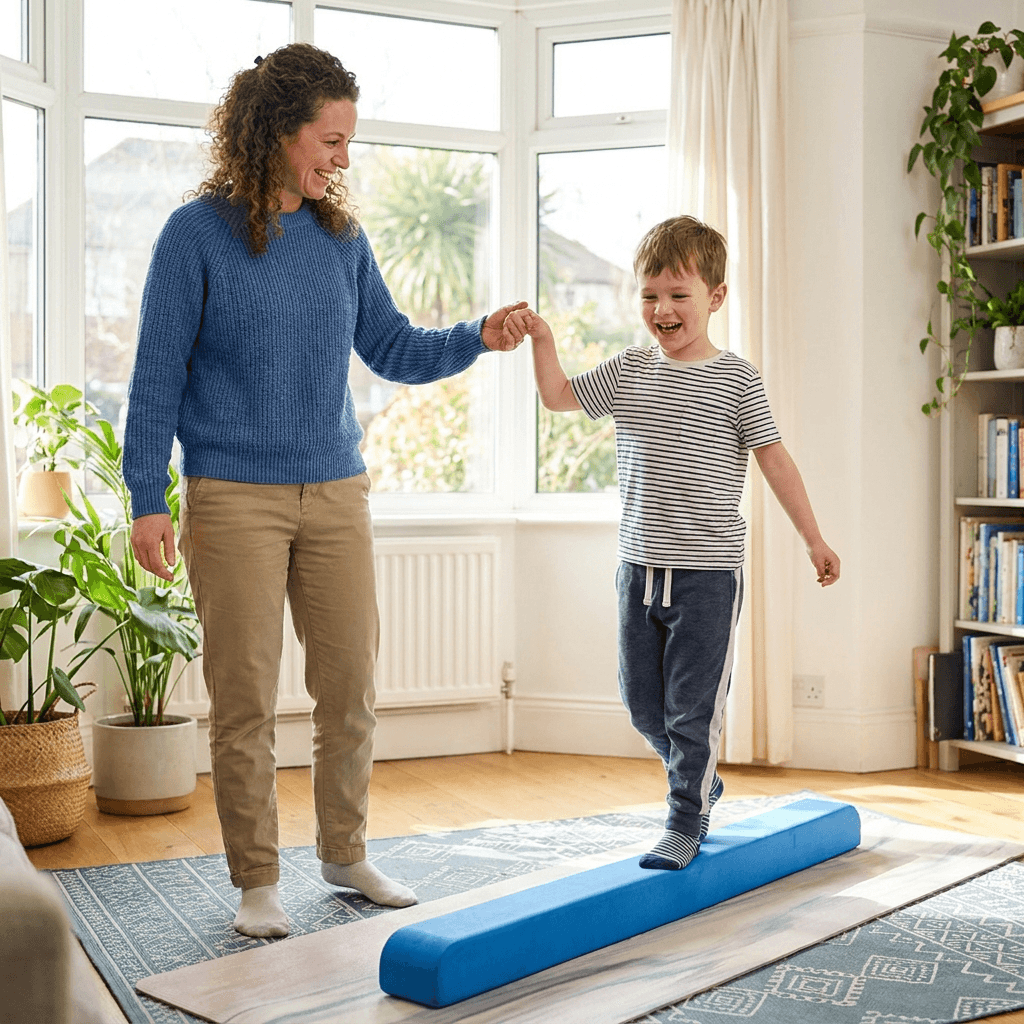
- Movement: Walks independently on most surfaces, though falls are still common. May attempt to climb low furniture and can usually stoop to pick something up without toppling.
- Imitation: Copies familiar household actions — putting a phone to the ear, stirring a pot, sweeping — which is a key way toddlers begin to understand the world around them.
- Social connection: Actively shows you objects simply to share interest or excitement, not just to request something. This "joint attention" is one of the most important social-communication skills of early childhood.
- Fine motor skills: Can hold a chunky crayon and make intentional marks on paper. May attempt to stack two or three blocks.
- Play: Begins simple pretend play, such as feeding a teddy or "drinking" from an empty cup.
Every child develops on their own curve — single skills arriving "late" are usually noise. Patterns across multiple areas are what matter.
Understanding the range: what "typical" actually means
Developmental milestones are population averages, not fixed deadlines. A child in a household where three languages are spoken simultaneously may produce fewer words in any single language at 15 months, yet have a combined vocabulary that is perfectly on track. Equally, a child who walked at 10 months is not necessarily more advanced than one who walks at 15 months — both fall within a healthy range.
Context also matters. Children who have had frequent ear infections, who were born prematurely, or who have had limited opportunity for floor-based play (common in the UAE's indoor, air-conditioned lifestyle during summer) may show slight lags in specific areas that resolve quickly with targeted support or simply more opportunity.
That said, context is not a reason to dismiss genuine concerns — it is a reason to discuss them with a professional who can interpret the full picture.
Red flags worth acting on
The following patterns deserve a conversation with a paediatrician or developmental specialist. They are not diagnoses, and one flag in isolation is a reason to pay attention, not to panic. However, the combination of several flags — or any regression — warrants prompt assessment.
- No words and no compensating gestures: A child who isn't yet talking but is actively pointing, waving, nodding, and reaching is communicating in a meaningful way. A child who has neither words nor intentional gesture is a higher priority for assessment.
- Not walking, with no clear physical explanation: Most children walk independently by 15 months. If yours is not yet doing so and there is no known orthopaedic or muscular reason, a paediatric physiotherapy review can help rule out any underlying concerns.
- Little interest in imitation games: Imitation is how toddlers learn virtually everything. A consistent pattern of not copying actions or sounds — particularly in interactive games like peekaboo or clapping — can sometimes indicate a need for support.
- Doesn't share attention or enjoyment: Joint attention (looking back and forth between an interesting object and your face, pointing to share excitement, or bringing you things to show you) is a foundational social-communication skill. Its consistent absence at 15 months is worth exploring.
- Loss of any previously mastered skill: Regression — words disappearing, loss of walking, withdrawal from social play — at any age and for any reason always deserves prompt assessment. This is one of the few truly urgent scenarios in developmental paediatrics.
One flag is a conversation, not a conclusion. Loss of any previously mastered skill, at any age, always deserves prompt assessment.
How to support your 15-month-old at home
Most of the most effective developmental support happens not in a clinic but during ordinary daily life. The following strategies are evidence-informed and practical in a UAE family context.
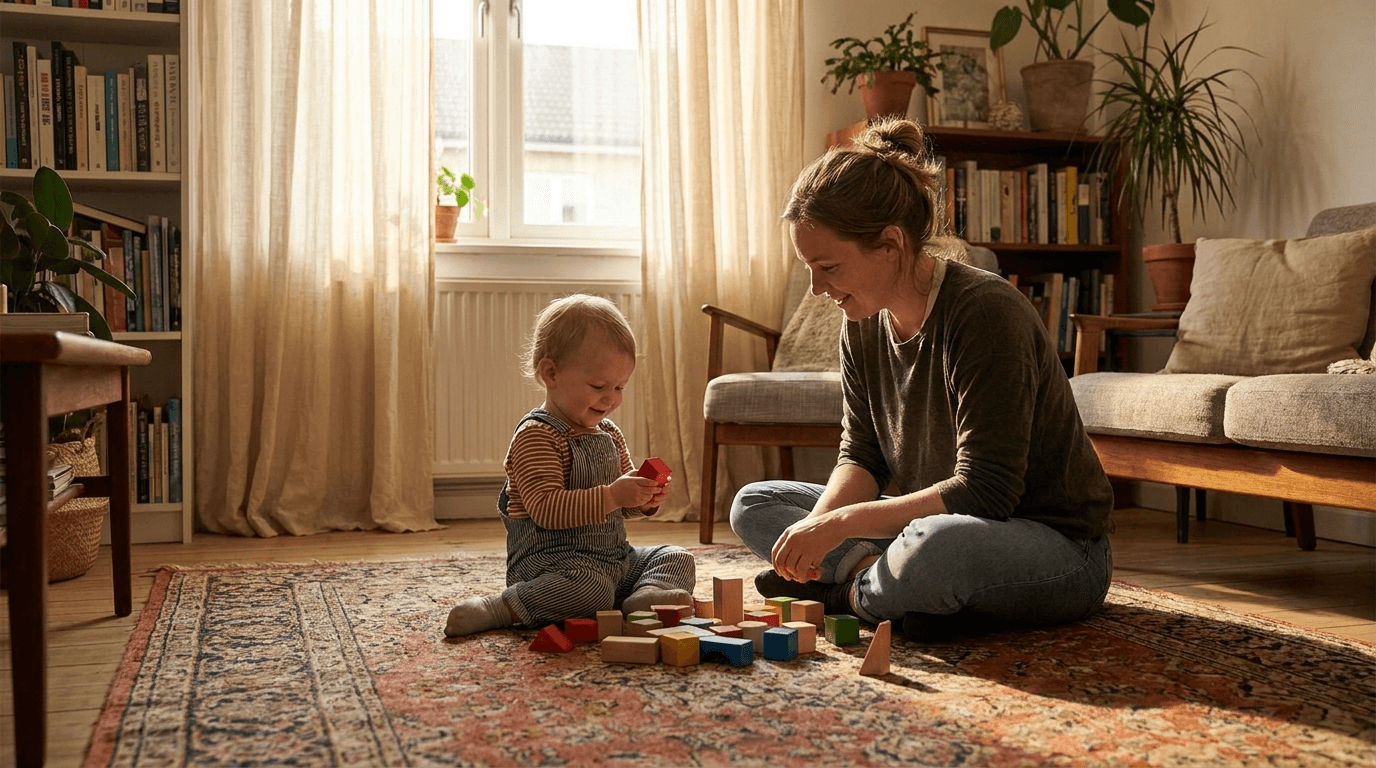
- Follow their lead: Let your toddler choose what to play with, then join in. Commentary on what they are doing ("you're stacking the blocks!") builds language far more effectively than drilling words.
- Make imitation a two-way street: Deliberately copy your child's actions — their babble, their clapping, their funny walk. When they notice you copying them, they are far more likely to copy you back. Imitation is the engine of toddler learning.
- Create communication opportunities: Rather than anticipating every need, pause and wait. Hold up two options and let your child reach, point, or attempt a word. These small moments build the habit of communication.
- Read together daily: Short, repetitive board books with clear pictures are ideal. You do not need to read every word — pointing, naming, and talking about the pictures together is just as valuable.
- Limit screen time: Current guidance recommends avoiding screen use in children under 18–24 months, with the exception of video calls with family. Background television may reduce the quality of parent–child verbal interaction even when no one is actively watching it.
- Floor time: In Dubai's climate, indoor time is a reality for much of the year. Dedicating unstructured floor time — where your child can move, explore, and lead — supports both gross motor and cognitive development.
Red flags in a multilingual UAE context
Many families in Dubai raise children in two, three, or even four languages simultaneously. Research generally suggests this is a cognitive advantage in the long term, but it can create ambiguity around language milestones. A useful practical guide: count all words across all languages. A child who says "mama" in Arabic, "water" in English, and "nein" (no) in German has three functional words regardless of the language they appear in. If the total across all languages is still well below expectation, that is worth discussing with a specialist.
When and how to seek help in Dubai
If you have concerns after reading this article, the best first step is usually your paediatrician. In the UAE, the Dubai Health Authority (DHA) and Department of Health Abu Dhabi both have frameworks for developmental assessment and early intervention, and many insurers cover paediatric therapy with a referral.
For families who prefer to begin closer to home, xlr8well provides speech therapy, ABA therapy, occupational therapy, and physical therapy delivered at your home anywhere in Dubai — removing the logistical friction that can delay families from seeking help. Therapy sessions can also take place at Bloom Autism Center (Office 702, Yes Business Tower, Al Barsha 1, Dubai). Importantly, a formal diagnosis is never required to begin — the team assesses and supports skills, not labels. Every journey starts with a free, judgement-free consultation on WhatsApp.
Explore autism therapy and developmental support services to learn more about what is available.
One thing to do this week
If there is a single, research-backed activity to prioritise right now, it is this: spend ten minutes today copying your child. Mimic their sounds, their movements, their play. Watch their face when they realise you are following their lead. That moment of connection — of a child discovering they can influence another person — is one of the earliest and most important building blocks of communication and social understanding.
This article is intended as general educational information for parents and caregivers. It is not a substitute for professional assessment of your individual child. If you have concerns about your child's development, please consult a licensed paediatrician or developmental specialist.