%2520(350%2520x%2520150%2520px)%2520(90%2520x%252040%2520px)%2520(4).png%3Falt%3Dmedia%26token%3Dbed5580f-de12-4061-ac20-36c16b313f14&w=384&q=75)
At-Home Electrocardiogram (ECG) in Dubai: Price, What's Included & How to Book at Home (2026)
What Is an Electrocardiogram (ECG)?
An electrocardiogram — commonly written as ECG (or EKG, from the German Elektrokardiogramm) — is a non-invasive diagnostic test that records the electrical signals produced by your heart with each beat. Every time your heart contracts, a small electrical impulse travels through the heart muscle in a precise sequence. Electrodes placed on the skin pick up these impulses and translate them into a series of waves on a graph. A trained clinician can then read that graph to assess the heart's rhythm, rate, and overall electrical health.
The test itself is entirely painless. No electrical current passes into your body; the electrodes simply listen. A standard 12-lead ECG — the most common clinical format — uses ten electrodes placed on the chest, arms, and legs to capture the heart's activity from twelve different angles, giving a thorough picture of how the electrical signal moves through each region of the heart muscle.
Why Have an ECG?
A doctor may recommend an ECG for a wide range of reasons. Common situations include:
- Palpitations or irregular heartbeat — a fluttering, racing, or pounding sensation that may indicate an arrhythmia.
- Chest pain, pressure, or tightness — an ECG can help identify or rule out cardiac causes of chest discomfort.
- Shortness of breath or unexplained fatigue — sometimes the first clue that the heart is under strain.
- Dizziness, light-headedness, or fainting episodes — which can have a cardiac origin.
- Pre-employment or insurance medicals — many UAE employers and insurers require a baseline ECG.
- Pre-operative assessment — surgeons and anaesthetists often request an ECG before elective procedures.
- Monitoring a known heart condition — to track changes in rhythm or electrical conduction over time.
- Routine cardiovascular screening — particularly for those over 40, or with risk factors such as high blood pressure, diabetes, or a family history of heart disease.
It is important to understand that an ECG is a snapshot in time. Some conditions — such as intermittent arrhythmias — may not be captured during a short recording. Your doctor can advise whether additional or longer-term monitoring is appropriate based on your symptoms and history.
What Can an ECG Detect?
While no single test can diagnose every cardiac condition, a 12-lead ECG can provide meaningful information about a number of common concerns:
- Arrhythmias — abnormal heart rhythms, including atrial fibrillation, atrial flutter, supraventricular tachycardias, and certain ventricular rhythm disturbances.
- Ischaemia and infarction — changes in the ECG waveform may indicate reduced blood flow to the heart muscle (ischaemia) or evidence of a previous heart attack (myocardial infarction).
- Conduction abnormalities — such as heart block or bundle branch blocks, where the electrical signal is delayed or travels an abnormal route.
- Chamber enlargement — patterns that may suggest the heart's chambers have enlarged in response to chronic pressure or volume overload.
- Electrolyte imbalances — significant disturbances in potassium, calcium, or magnesium levels can produce characteristic ECG changes.
- Effects of certain medications — some drugs affect the heart's electrical intervals, and an ECG helps monitor for these changes.
An ECG finding always needs to be interpreted in the context of your full medical history and symptoms. An abnormal result does not automatically mean a serious problem, and a normal result does not always rule one out. Always discuss your ECG report with a licensed doctor.
How the At-Home ECG Works
Before the Appointment
No significant preparation is usually needed. It helps to:
- Wear comfortable, loose-fitting clothing that allows easy access to the chest, ankles, and wrists.
- Avoid applying body lotion or oils to the chest area on the day, as these can reduce electrode contact.
- Rest quietly for a few minutes beforehand — physical activity immediately before the recording can temporarily affect the trace.
- Bring a list of any medications you are taking, as these may be relevant to interpretation.
During the Appointment
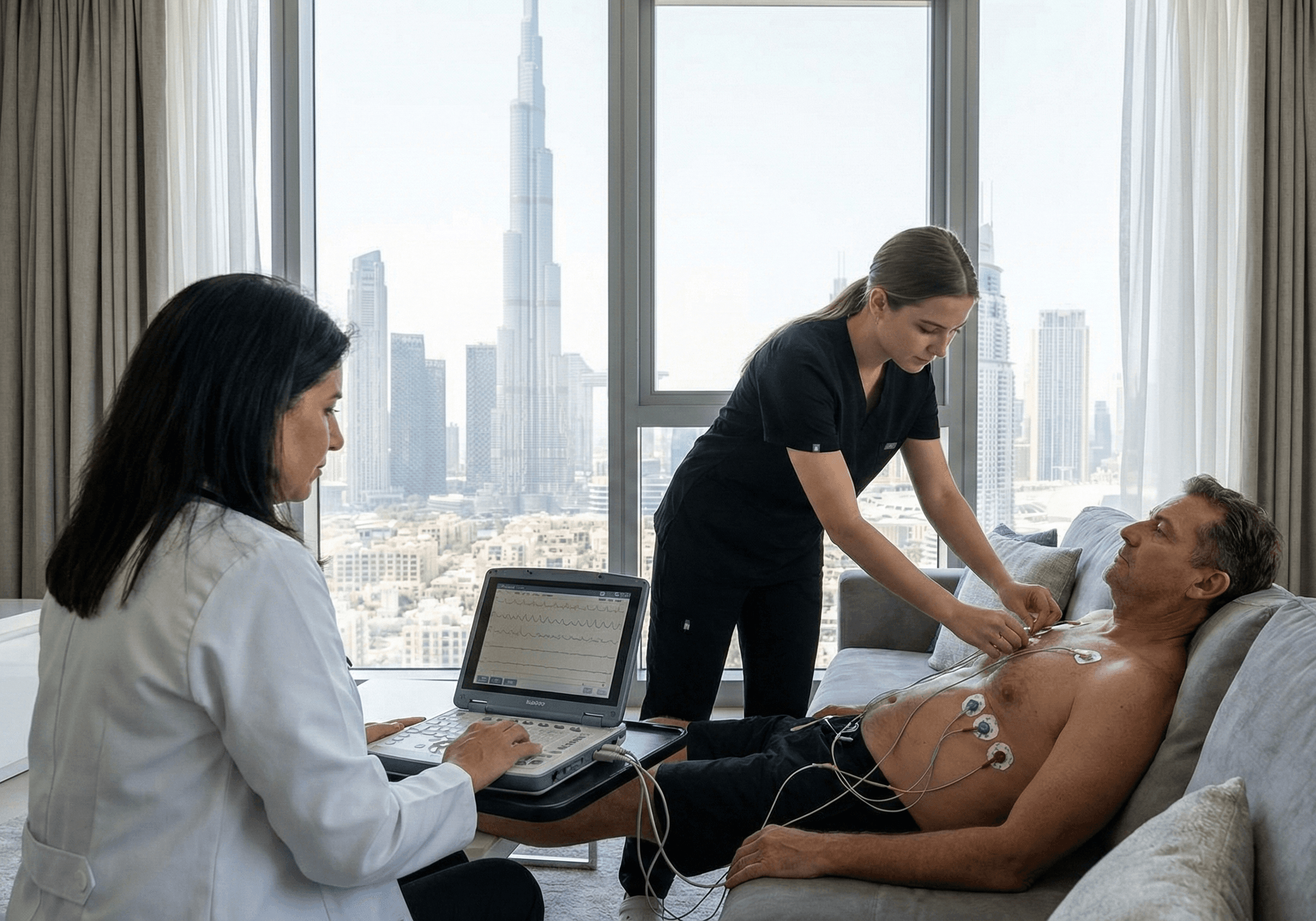
A DHA-licensed healthcare professional visits your home at your chosen time. The procedure typically takes 20 to 30 minutes in total, including set-up and the recording itself. You will be asked to lie still on a flat surface. Ten small electrodes (sticky patches) are attached to specific positions on your chest, arms, and legs. You breathe normally and remain still for around 10 seconds while the machine records the electrical activity. The electrodes are then removed — there is no discomfort, and no marks are left on the skin.
After the Appointment
The ECG trace is processed and the report is delivered to your private xlr8well dashboard, keeping your health data accessible and confidential. If you have added a doctor review to your booking, a clinician will interpret the findings and provide guidance on next steps. It is strongly recommended that the ECG result is reviewed by a qualified doctor, particularly if you booked the test in response to symptoms.
At-Home ECG in Dubai: Practical Considerations
Dubai's climate and lifestyle can place particular demands on cardiovascular health. Long working hours, high ambient temperatures for much of the year, a fast-paced urban environment, and dietary patterns that may differ significantly from those in one's home country can all be relevant factors for heart health. Regular cardiovascular monitoring is sensible for many UAE residents — not only those with known risk factors.
Having an ECG performed at home removes several common barriers: no need to navigate traffic to a clinic, no waiting rooms, and the comfort of a familiar environment, which can be especially helpful for individuals who experience healthcare anxiety or have mobility limitations. xlr8well's DHA-licensed professionals bring clinical-grade equipment to your door, anywhere in Dubai, with same-day and next-day slots generally available.
Safety, Limitations, and When to Seek Emergency Help
An ECG is an extremely safe procedure with no known risks — it does not deliver any electrical current and carries no radiation exposure. However, it is a diagnostic aid, not a treatment, and has real limitations:
- It captures only the moment of recording. Transient symptoms that are not occurring during the test may not be reflected.
- It is not a substitute for a full cardiac assessment when symptoms are ongoing or severe.
- Interpretation requires clinical expertise — the automated analysis produced by ECG machines is a guide, not a final diagnosis.
Important: If you are currently experiencing chest pain, severe shortness of breath, loss of consciousness, or symptoms that suggest a heart attack or stroke, do not wait for a home appointment. Call 999 immediately or go to the nearest emergency department. An at-home ECG is for non-emergency assessment only.
How to Book
xlr8well offers at-home ECG services across Dubai. You can book online or via WhatsApp, select a convenient time slot, and a DHA-licensed professional will come to you. Results are delivered securely to your xlr8well dashboard, and an optional doctor review can be added to your booking for clinical interpretation and advice.
Browse all Doctor at Home services, or explore related options such as the At-Home Shingles Vaccine and the Testosterone Optimization Program.