%2520(350%2520x%2520150%2520px)%2520(90%2520x%252040%2520px)%2520(4).png%3Falt%3Dmedia%26token%3Dbed5580f-de12-4061-ac20-36c16b313f14&w=384&q=75)
6 Months Milestones: What to Expect, Red Flags & How to Help
TL;DR: At 6 months, most children roll both ways, push up on their arms, and babble with consonant sounds (ba, da, ga). Red flags such as no social smiling or shared joy deserve a professional conversation — early support changes trajectories, and waiting rarely helps.
Why Six Months Matters
The first year of life is one of the most dynamic periods of human development. By the halfway point — six months — the brain is growing at a remarkable pace, forming connections that underpin movement, language, social bonding, and thinking. Understanding what is typical at this stage helps parents and caregivers notice when a child may benefit from extra support, and feel reassured when development is on track.
It is important to approach milestones as a general guide rather than a strict checklist. Children develop along their own individual curves, influenced by temperament, environment, prematurity, and many other factors. A single skill arriving a little later than average is usually unremarkable. It is patterns across multiple areas — or the loss of skills already gained — that deserve closer attention.
What Most Children Do at Six Months
Developmental milestones are grouped into four broad domains: motor (movement), communication and language, social and emotional, and cognitive (thinking and problem-solving). Here is what is typically observed across each area at around six months.
Motor Development
- Rolls from tummy to back and back to tummy (both directions)
- Pushes up onto straight arms during tummy time
- Begins to sit with support, and some children briefly without
- Reaches for and grasps objects with a whole-hand grip
- Transfers objects from one hand to the other
- Brings objects — and everything else — to the mouth to explore
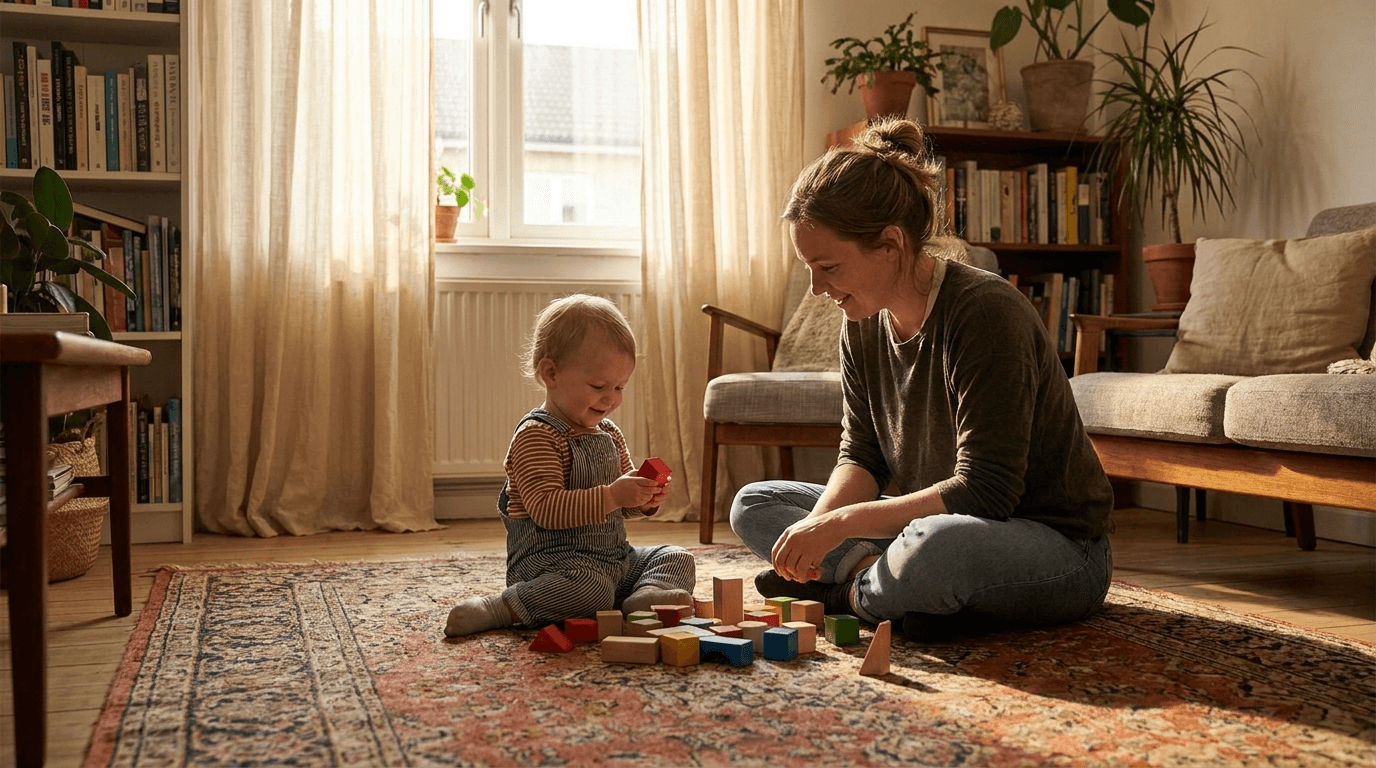
Tummy time is the foundation of most of these motor skills. In the UAE's warm indoor climate, many babies spend a lot of time in bouncers, car seats, or prams. Every minute of supervised floor time on the tummy or back supports muscle strength in the neck, shoulders, and core — the building blocks for sitting, crawling, and eventually walking.
Communication and Language
- Babbles with consonant-vowel combinations: ba, da, ga, ma
- Varies pitch and volume — sometimes loud, sometimes soft
- Turns toward familiar voices and reacts to their own name
- Turns toward the source of sounds in the environment
Babbling is not random noise — it is a child's first practice run at spoken language. Each consonant sound added to the repertoire represents growing coordination between the brain, mouth, and breath. Responding warmly to babble (talking back, imitating sounds, narrating daily routines) encourages more of it.
Social and Emotional Development
- Produces big social smiles and belly laughs, especially during play
- Shows clear preferences for familiar caregivers
- May show mild wariness around strangers
- Looks to caregivers' faces for emotional cues ("social referencing")
- Enjoys back-and-forth "conversations" — vocalisations, pauses, responses
Shared joy is one of the most meaningful markers at this age. When a child and caregiver both delight in the same moment — a funny face, a peekaboo game, a favourite toy — this joint attention is laying the groundwork for social understanding and eventually for language itself.
Cognitive Development
- Explores objects by mouthing, banging, and shaking
- Begins to understand cause and effect (shaking a rattle makes noise)
- Recognises familiar people and objects
- Shows curiosity about their surroundings
Red Flags Worth Acting On
The following signs, if present or persistent at six months, are worth raising with a paediatrician or developmental specialist promptly. Remember: one flag is a conversation, not a conclusion. And loss of any previously mastered skill — at any age — always deserves prompt assessment, without waiting.
- No social smiling or expressions of shared joy
- Not turning toward sounds or voices
- No babbling or vocalisation with consonant sounds
- Very stiff (high tone) or very floppy (low tone) muscle tone
- Not reaching for or grasping objects
- Consistent difficulty with feeding or swallowing
- No eye contact or very limited engagement with caregivers
Early identification of developmental differences — whether related to motor skills, communication, sensory processing, or social development — opens the door to intervention during a period when the brain is highly adaptable. This does not mean that support later in childhood is ineffective, but earlier is generally considered more advantageous by developmental specialists.
How to Support Development at Home
Parents are a child's first and most important developmental environment. Small, consistent everyday habits can make a meaningful difference.
Prioritise Floor Time Over Container Time
Every minute out of bouncers, rockers, and prams — on a safe, flat surface — is an opportunity for motor development. Aim for supervised tummy time several times throughout the day, building up gradually. If your baby protests, start with short sessions and use toys, mirrors, or your own face to make it engaging.
Talk, Sing, and Narrate
You do not need special materials. Narrating your day ("Now we're changing your nappy," "Look — the fan is spinning") exposes children to vocabulary, rhythm, and the patterns of language. Singing slows down speech into clear syllables and is particularly effective for early language learning.
Follow the Child's Lead
Notice what your baby is looking at or reaching for, and comment on it. This kind of joint attention — where both of you focus on the same thing — is one of the most powerful ways to support both language and social development.
Reduce Screen Exposure
Most paediatric guidelines suggest avoiding screen media (other than video calls with family) for children under 18–24 months. Live, responsive human interaction is what drives early development, and screens cannot replicate it.
When and How to Seek Help in Dubai
If you have concerns about your child's development — even a quiet instinct that something feels different — it is always appropriate to seek a professional opinion. You do not need to wait for a diagnosis, and you do not need to have multiple red flags. A single concern is enough reason to have a conversation.
In the UAE, paediatricians registered with the Dubai Health Authority (DHA) can provide initial developmental screening and referrals. Speech and language therapists, occupational therapists, physiotherapists, and behaviour specialists can also be consulted directly for assessment and support.
The xlr8well team delivers speech therapy, ABA therapy, occupational therapy, and physical therapy at home across Dubai — removing the logistical challenge of clinic visits with a young child. Therapy is also available at Bloom Autism Center (Office 702, Yes Business Tower, Al Barsha 1, Dubai). A diagnosis is never required to begin, and every journey starts with a free, judgement-free consultation on WhatsApp. Explore our autism therapy services to learn more.
A Note on Milestones and Anxiety
Milestone information is widely available online, and for many parents it is a source of reassurance. For others, it can fuel worry. It helps to remember that milestone ages represent ranges, not deadlines, and that a skilled therapist or paediatrician looking at your specific child will always provide more meaningful guidance than any article or checklist. If in doubt, ask — that is what professionals are there for.
This article is general information for parents and caregivers, not a diagnosis or a substitute for professional assessment of your individual child. If you are concerned about your child's health or development, please consult a licensed healthcare professional.