%2520(350%2520x%2520150%2520px)%2520(90%2520x%252040%2520px)%2520(4).png%3Falt%3Dmedia%26token%3Dbed5580f-de12-4061-ac20-36c16b313f14&w=384&q=75)
Screen Time and Speech Development: What the Research Actually Says
Screen Time and Speech Development: What the Research Actually Says
TL;DR: The association between screen time and slower language development is real but nuanced. Passive, solo screen time displaces the back-and-forth conversation that language is built from. Co-viewed, interactive, and time-limited screen use sits in an entirely different category from hours of background television running in the corner of the room.
Why Language Development Is So Time-Sensitive in Early Childhood
The first three years of life represent a period of remarkable neurological growth. The brain is forming and pruning connections at a pace it will never repeat, and spoken language is one of the primary ways those connections are shaped. Children do not learn language by simply hearing words — they learn it through interaction: a parent speaks, the child responds or reacts, the parent responds back. Researchers sometimes call these exchanges "serve and return," borrowing the metaphor from tennis. Each rally builds vocabulary, grammar, and the social understanding that language is for communication, not just reception.
The quantity and quality of these exchanges in the first years of life can have a lasting influence on a child's language ability, literacy, and even later academic outcomes. This is why anything that reduces conversational turns — whether screens, stress, overcrowded schedules, or simply a very quiet household — is worth paying attention to.
What the Research Broadly Shows
A growing body of research has examined the relationship between screen exposure and language milestones. The picture that emerges is consistent in some ways and complicated in others.
- Passive solo viewing is the main concern. When a child watches content alone, without an engaged adult, language input is one-directional. On-screen characters speak, but they cannot respond to the child, notice a puzzled expression, or adjust their vocabulary. The child receives input without the conversational loop that drives language learning.
- Background television has a measurable effect. Studies have found that when television runs in the background — even programmes aimed at adults — parent word counts directed at young children drop noticeably. The adult's attention is split; natural narration and commentary diminish. Fewer words spoken to the child means fewer conversational turns and less language practice.
- The mechanism is largely displacement. Screens are not necessarily toxic in a direct neurological sense; rather, time spent in front of a screen is time not spent in the face-to-face interactions that build language. An hour of solo viewing is an hour without serve-and-return exchanges. Over days and weeks, that accumulates.
- Age matters considerably. The concern is highest in children under two, whose brains are in the most intensive phase of language acquisition and who gain the least from screen content relative to older children. Current guidance from major paediatric bodies recommends minimising screen use for children under 18–24 months, with the exception of video calls with known family members.
- Not all screen time is equal. High-quality, slow-paced, educational programming designed specifically for young children is meaningfully different from fast-edited content or adult television. Interactive apps that require touch and response differ from passive streaming. The research does not support treating all screen exposure as a single uniform risk.
The Case for Co-Viewing
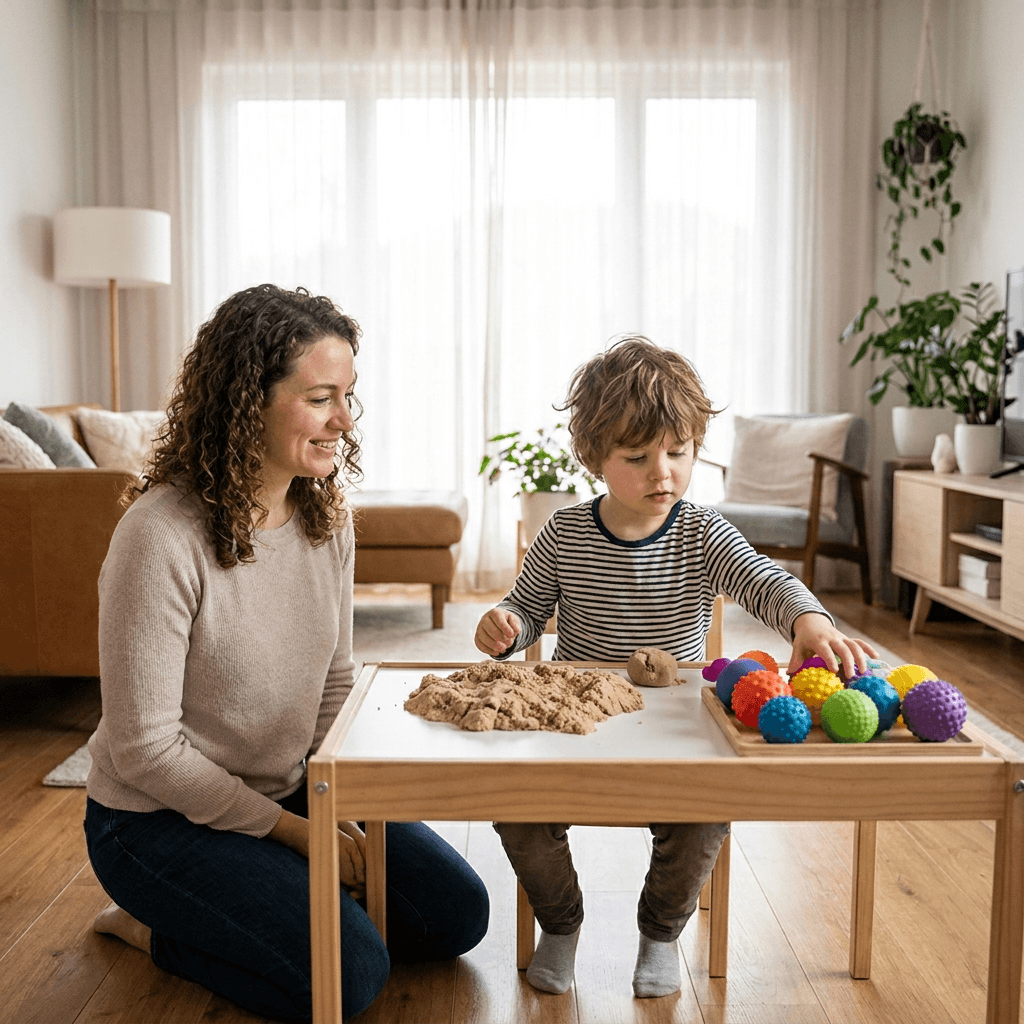
One of the most important and practical findings in this area is that an engaged adult sitting alongside a child can fundamentally change what screen time does to language development. When a parent or caregiver watches with a child and talks about what is happening — "look, the dog is hiding behind the chair!", "what do you think she'll do now?" — the screen becomes a shared experience and a prompt for conversation rather than a substitute for it.
Co-viewing effectively converts passive input into interactive dialogue. The child still sees the screen content, but they also receive adult narration, questions, reactions, and responses to their own vocalisations. This mirrors the kind of language-rich environment that supports development — the screen just provides the topic.
This does not mean co-viewing eliminates all concerns, or that unlimited co-viewed screen time is without consequence. But it does mean that context and engagement matter enormously, and that the goal for parents is not necessarily to eliminate screens entirely but to be thoughtful about how, when, and with whom they are used.
Practical Guidance for UAE Families
Families in Dubai and across the UAE face some particular pressures that are worth acknowledging. Busy working schedules, multigenerational households, domestic helpers who may speak a different language from the parents, and a multilingual environment can all shape how and how much children are exposed to screens. There is no one-size-fits-all answer, but a few practical principles apply broadly.
- Swap, don't just cut. Rather than approaching screen time with guilt or a strict all-or-nothing rule, consider substitution. One screen slot replaced with a book-reading and conversation session each day compounds significantly over months. The goal is more conversational turns, not perfection.
- Be present during viewing. Sitting alongside your child, naming what you see, asking simple questions, and reacting together changes the quality of the experience substantially.
- Switch off background television. This single change can meaningfully increase the number of words directed at a young child during daily routines like mealtimes and play.
- Narrate everyday life. Language-building does not require structured activities. Describing what you are doing during nappy changes, cooking, or a walk to the shops provides natural, contextualised language input that screens cannot replicate.
- In multilingual households, consistency matters. Children raised with more than one language — common across Dubai's diverse population — can achieve strong language development in all their languages. The important thing is that each language is used consistently and interactively, rather than delegated entirely to screen content.
When Should Parents Seek a Professional Opinion?
Speech and language development follows a broad range of timelines, and variation between children is normal. However, there are some signs that warrant a professional assessment rather than a watchful wait. These include a child who has very few or no words by 12–15 months, who is not combining words by age two, who has lost words or skills they previously had, or whose communication seems to be affecting their play and social interaction. If screen habits have been a concern and a child also seems to be behind their peers in language milestones, a speech and language therapy assessment is a sensible next step.
Early support, when it is needed, tends to be more effective than delayed support. An assessment either identifies where help is needed and sets a clear plan in motion, or it provides well-founded reassurance — both of which are valuable outcomes for a concerned parent.
Speech and Language Therapy at Home in Dubai
For families in Dubai and across the UAE, xlr8well's licensed speech-language pathologists offer speech and language therapy delivered at your home, removing the logistical challenge of clinic visits with young children. Sessions are also available at Bloom Autism Center (Office 702, Yes Business Tower, Al Barsha 1, Dubai). Every engagement begins with a thorough assessment, establishes measurable goals, and includes parent coaching so that families can extend the work of each session into daily life — which is precisely where language development happens.
This article is general information for parents and caregivers. It is not a diagnosis and is not a substitute for professional assessment of your individual child. If you have concerns about your child's development, please consult a licensed healthcare professional.