%2520(350%2520x%2520150%2520px)%2520(90%2520x%252040%2520px)%2520(4).png%3Falt%3Dmedia%26token%3Dbed5580f-de12-4061-ac20-36c16b313f14&w=384&q=75)
The 6 Stages of Play: How Children Learn to Be Social
Introduction: Why Play Is Serious Business
To an adult passing by, children at play can look effortless — a toddler stacking blocks alone, two pre-schoolers running in parallel orbits, a group of six-year-olds deep in the drama of an imaginary kingdom. What is easy to miss is that each of these scenes represents a distinct, purposeful stage of social and cognitive development. Play is, in the truest sense, a child's work.
In the 1930s, developmental psychologist Mildred Parten observed young children and identified a progression in how they engage with others. Her framework — refined and expanded by later researchers — gives parents and caregivers a remarkably useful map. Rather than a checklist of milestones to tick off anxiously, it is a sequence that reveals where your child is developmentally right now, and what naturally comes next.
The Six Stages of Play, Explained
It is worth noting from the outset that these stages overlap, and children frequently move between them depending on their mood, environment, and the children around them. A healthy eight-year-old may still choose solitary play after a tiring school day. The stages describe what tends to emerge and predominate at each age — not rigid boxes.
Stage 1: Unoccupied Play (Birth to Around 3 Months)
In the very earliest weeks, babies are not yet playing in any recognisable sense. They move their bodies apparently at random, observing their environment with wide, absorbing eyes. This seemingly purposeless activity is actually the foundation — the nervous system is calibrating, sensory pathways are forming, and the seeds of curiosity are being planted.
Stage 2: Solitary Play (Around 0–2 Years)
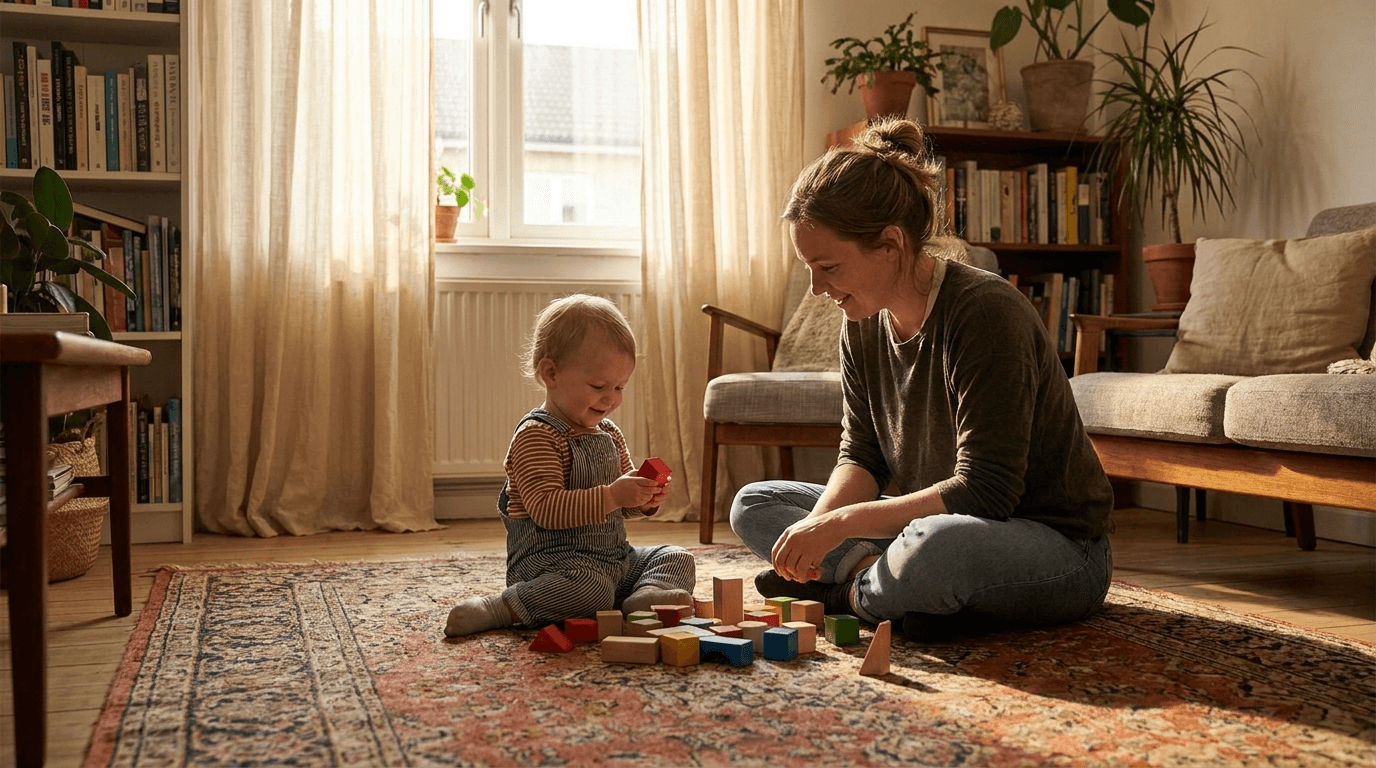
A young toddler absorbed in a pile of building blocks, entirely content with no audience or companion, is displaying healthy, complete development. Solitary play is not loneliness — it is the essential work of self-discovery. Children learn about cause and effect, develop fine motor skills, and begin to understand how objects behave. There is no need to nudge a child out of this stage prematurely. It provides the cognitive and emotional scaffold for everything that follows.
Stage 3: Onlooker Play (Around 2 Years)
A child watches other children play, sometimes asking questions or commenting, but does not join in. This is not shyness or disinterest — it is information-gathering. The child is studying the social rules of play: how do children negotiate, how do they share space, what happens when someone says no? Onlooker behaviour is an active, intelligent precursor to participation.
Stage 4: Parallel Play (Around 2–3 Years)
Two toddlers sit at the same sand tray, each building their own creation, occasionally glancing at what the other is doing but rarely interacting directly. This is parallel play, and it is one of the most important bridges in social development. Children are learning proximity tolerance, awareness of others, and the early grammar of turn-taking — all without the pressure of direct interaction. An adult playing alongside, narrating their own actions quietly ("I'm making a road here"), models participation without demanding it.
Stage 5: Associative Play (Around 3–4 Years)
Now children begin to interact — sharing materials, commenting on each other's work, joining the same loose activity — but each child still follows their own agenda. In a pre-school art corner, three children may be using the same paints and chatting about what they are making, yet each is painting something entirely different. Associative play is socially rich but not yet organised. There is no shared goal, no leader, no assigned roles. It is social experimentation in its most forgiving form.
Stage 6: Cooperative Play (Around 4–6 Years and Beyond)
This is the stage that most adults picture when they think of children "playing together." Children now agree on a shared goal, assign roles, negotiate rules, and adapt to one another. Building a fort, acting out a story, playing football — all require the capacity to hold a shared mental plan, manage disappointment, and repair social ruptures when they occur. Cooperative play is cognitively and emotionally demanding, and it is the training ground for the collaboration skills children will use throughout their lives.
A final stage sometimes added to Parten's original framework is games with rules — structured activities where external, agreed-upon rules govern behaviour. Board games, organised sports, and playground games like tag all fall here. This stage, typically emerging from around age five or six, demands impulse control, fairness reasoning, and the ability to lose gracefully.
What This Means for Parents: Meeting Your Child One Stage Up
Understanding the stages transforms how you can support your child. The principle is simple: meet your child where they are, and gently model the next step — never demand it.
- If your child is in solitary play: Join them quietly with your own activity nearby. Let them lead, comment without instruction, and make your presence enjoyable rather than directive.
- If your child is in parallel play: Sit beside them, narrate what you are doing, mirror their actions. Interaction will emerge naturally when they are ready.
- If your child is in associative play: Introduce shared projects loosely — building something together, cooking side by side. Celebrate contribution without requiring conformity to a single plan.
- If your child is developing cooperative play: Introduce simple board games, collaborative crafts, and imaginative role-play. Coach conflict resolution in the moment, calmly and without shame.
In Dubai's fast-paced, screen-rich environment, one of the most practical things parents can do is create regular unstructured time — play dates without agendas, outdoor time without scheduled activities — where these stages can unfold at their own pace.
Play, Culture, and the UAE Context
It is worth acknowledging that play looks different across cultures, and the UAE's diverse, multilingual population means children are navigating social norms from multiple directions at once. Children in Dubai may be learning to play alongside peers from very different backgrounds, and this can enrich the process — but it can also add complexity. Bilingual and multilingual children sometimes progress through social play stages at a slightly different pace, which is typically a sign of the additional cognitive load they are managing, not a cause for concern.
The heat of Dubai summers also means that indoor play dominates for much of the year. Structured indoor environments like play gyms and enrichment centres can support development, but free, child-led play in a familiar home setting is where many children feel safest to take social risks and move through the stages naturally.
When Development May Need a Closer Look
Every child develops at their own pace, and variation is entirely normal. However, if you notice that your child's play behaviour has not progressed meaningfully over several months, or if they seem persistently unable to engage even in parallel play with peers well past the age of three, it may be worth seeking a professional perspective.
Signs that warrant a conversation with a qualified professional include:
- A strong, consistent preference for being alone that causes distress when proximity to peers is unavoidable
- Difficulty imitating others' actions or gestures during play
- Limited or absent pretend or imaginative play by age three
- Persistent challenges with turn-taking or understanding simple shared rules by age five or six
- Significant regression in play behaviour following a developmental milestone
A professional assessment — which can include speech and language evaluation, occupational therapy assessment, and developmental screening — does not necessarily lead to a diagnosis. Often, it provides exactly what worried parents need most: a clear picture and a practical plan.
xlr8well's therapists offer speech and language therapy, occupational and sensory therapy, and developmental support in the home environment across Dubai — where children tend to show their truest abilities — as well as at Bloom Autism Center (Office 702, Yes Business Tower, Al Barsha 1, Dubai).
A Note on Screens and Play
Many parents in the UAE ask about the impact of screen time on play development. While interactive, co-operative digital games can involve some elements of the later play stages, passive screen consumption does not replicate the physical, emotional, and social learning that embodied play provides. Most early-years specialists recommend that unstructured physical play with people and objects remains a central part of young children's daily lives, and that screen time is balanced thoughtfully rather than eliminated entirely. If in doubt about balance, your child's paediatrician is a good first point of contact.
The Bottom Line
Play is not a break from learning — it is the primary vehicle through which children learn to be human together. Parten's six stages offer parents something rare: a framework that converts everyday observations into insight. Your child playing alone is not behind. Your child watching from the sidelines is not shy. Your child beside another child, not yet with them, is building the bridge. Each stage is complete in itself, and each one carries your child forward.
This article is general information for parents and caregivers, and is not a diagnosis or a substitute for professional assessment of your child.