%2520(350%2520x%2520150%2520px)%2520(90%2520x%252040%2520px)%2520(4).png%3Falt%3Dmedia%26token%3Dbed5580f-de12-4061-ac20-36c16b313f14&w=384&q=75)
Why Dubai Is Done With Clinic Queues: The Rise of At-Home Blood Testing

The 3-Hour Errand That Became a 15-Minute Visit
The old routine will be familiar to almost anyone who has lived in Dubai for more than a few months: search for an available appointment slot, navigate cross-town traffic, find parking, sit in a waiting room alongside other patients, finally get the blood draw, then reverse the entire journey home. Half a morning — sometimes more — quietly evaporates. Work calls pile up. Children need collecting. The irony is that the actual blood draw takes less than five minutes.
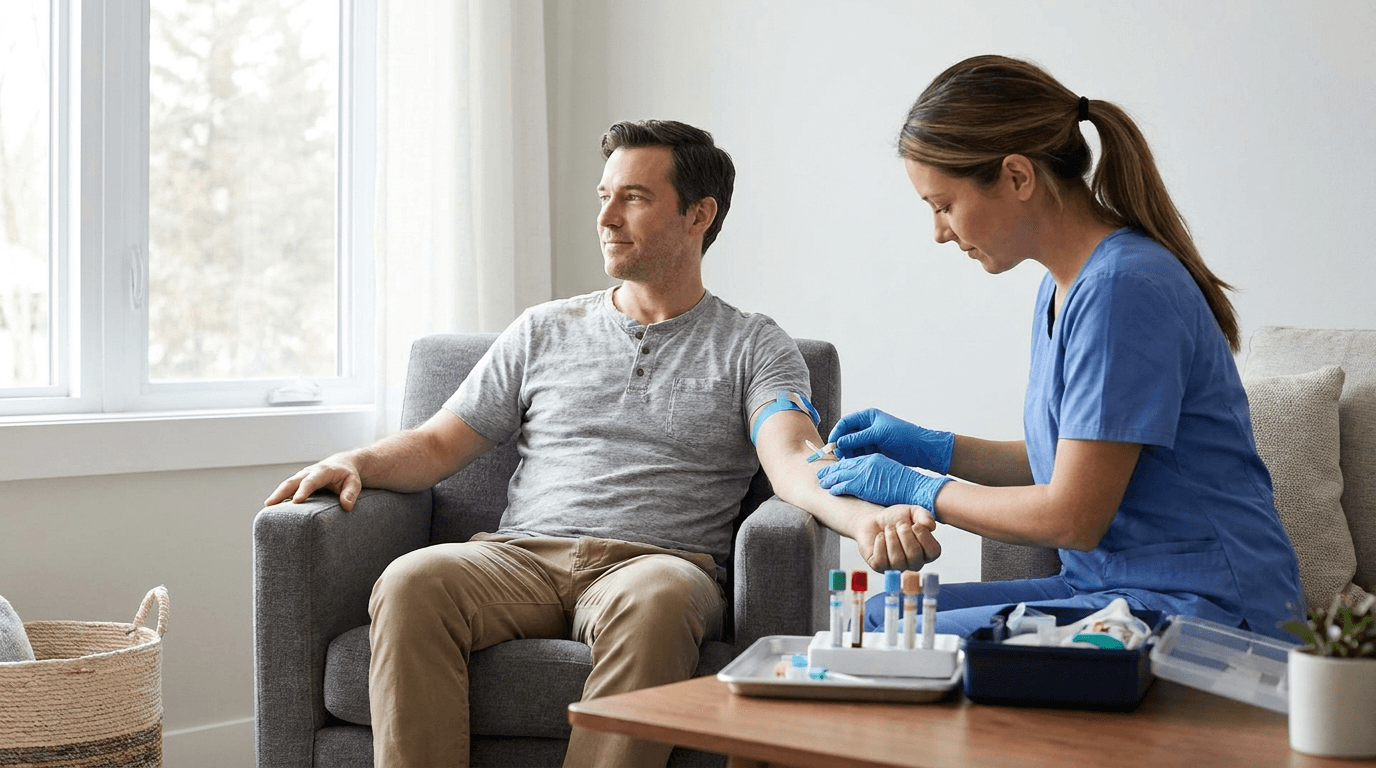
The new routine looks rather different. A DHA-licensed nurse rings your doorbell at a time you have chosen. You sit at your kitchen table, or on your sofa, or wherever is comfortable. The sample is collected in around 15 minutes, the nurse leaves, and your results appear in your secure online dashboard within 24 to 48 hours. xlr8well offers exactly this service across Dubai and the wider UAE, bringing professional phlebotomy directly to your home, office, or hotel room.
It sounds almost too straightforward — which is why the most common question is whether anything is being sacrificed for the convenience.
Is At-Home Blood Testing as Accurate as a Clinic?
This is the right question to ask, and the answer is reassuring. The accuracy of a blood test depends on two things: the quality of the sample collection and the quality of the laboratory analysis. Neither of those changes when the collection happens at home rather than in a clinical setting.
At-home phlebotomists use the same vacuum-tube collection systems found in hospitals and private clinics. Proper vein selection, correct tube fill volumes, appropriate inversion technique, and cold-chain transport all follow the same protocols. When samples reach a CAP-accredited laboratory — the gold-standard accreditation used by leading diagnostic facilities worldwide — they are processed on the same equipment and by the same scientists as any other sample. The sofa you were sitting on genuinely does not change the chemistry.
What can introduce error anywhere — at home or in a clinic — is poor preparation by the patient. Some panels require an overnight fast, others are time-sensitive relative to your menstrual cycle or medication schedule. A reputable at-home provider will brief you clearly on any preparation requirements before the nurse arrives, which is itself an advantage: you are far more likely to have fasted correctly at home than after an impromptu dash to a walk-in clinic.
What Can You Actually Test at Home?
The breadth of testing available at home has expanded considerably. A useful way to think about it is by category:
- General health and preventive screening — full blood count, comprehensive metabolic panel, cholesterol and lipid profile, liver function, kidney function, iron studies, HbA1c (long-term blood sugar), vitamin D, vitamin B12, and ferritin. These are the markers most relevant to annual health MOTs and chronic disease monitoring.
- Hormonal health — testosterone (total and free), thyroid function (TSH, T3, T4), cortisol, DHEA-S, oestrogen, progesterone, LH, FSH, prolactin, and AMH for ovarian reserve. Hormonal panels are particularly well suited to home testing because stress — including the stress of navigating a busy clinic — can transiently alter certain hormone readings.
- Specialist and advanced panels — DNA-based health insights, gut microbiome analysis, food intolerance and allergy testing, and comprehensive DUTCH hormone mapping, which uses dried urine rather than blood and assesses how the body metabolises hormones over a full day.
- Sexual health — discreet STI and STD panels with fully confidential results, designed for people who may find a clinic setting a barrier to getting tested regularly.
- Chronic condition monitoring — quarterly or six-monthly marker reviews for conditions such as hypothyroidism, type 2 diabetes, and cardiovascular risk, removing the logistical friction that often causes people to delay or skip follow-up tests.
Browse more than 60 panels on the at-home blood testing page, or build your own test marker by marker if you have a specific concern in mind.
Who Benefits Most From Home Blood Testing?
The honest answer is: most adults in Dubai, for different reasons.
- Busy professionals who cannot realistically take two hours out of a working day for a routine draw. A nurse arriving at the office between meetings is a practical alternative.
- Parents managing school runs, after-school activities, and the general unpredictability of family life. Testing from home removes the need to arrange childcare around a clinic appointment.
- Expats new to the UAE who are still navigating the healthcare system and may not yet have an established GP relationship or know which clinics accept their insurance for diagnostics.
- People managing chronic conditions such as thyroid disorders, diabetes, or cardiovascular risk factors who need regular monitoring but find the logistical overhead of quarterly clinic visits genuinely burdensome over time.
- Anyone practising proactive or preventive health — increasingly common in Dubai, where awareness of biohacking, longevity medicine, and personalised wellness has grown substantially. Regular biomarker tracking is only sustainable if the process is easy enough to repeat.
- Those who face anxiety in clinical settings, including needle anxiety that is exacerbated by an unfamiliar environment, or people who simply feel more at ease in their own home.
There is also a subtler benefit worth naming: the psychological barrier of "I'll book it next week" is much lower when booking means choosing a two-hour window and unlocking your front door. Preventive testing that actually gets done is categorically more useful than perfect testing that keeps being postponed.
What to Expect on the Day
The process is designed to be as frictionless as possible. After booking, you will receive confirmation of any pre-test preparation required — fasting instructions, timing guidance relative to medication, or specific sample collection requirements if your panel includes a urine or saliva component. On the day, the nurse arrives within your chosen window, verifies your identity, confirms the panel, performs the draw (typically two to four minutes), labels and packages the samples for transport, and leaves. Most people describe it as less stressful than a clinic visit, in part because there is no waiting and no unfamiliar environment.
Results are uploaded to your secure dashboard, usually within 24 to 48 hours depending on the specific markers ordered. Some specialist panels — gut microbiome, DUTCH, DNA — have longer turnaround times and this will be communicated clearly at the point of booking.
Understanding Your Results: The Importance of Clinical Context
A blood test result is a data point, not a diagnosis. Reference ranges on lab reports represent population averages and are a useful starting point, but what is optimal for your age, sex, health history, and lifestyle may differ from what is simply flagged as "normal" or "abnormal" on a printout. If any of your results fall outside range — or if you have symptoms that prompted the test in the first place — it is important to discuss findings with a licensed doctor who can interpret them in the context of your full health picture.
xlr8well can help facilitate follow-up consultations where appropriate. At no point should a blood test result replace a proper clinical assessment, and this is as true for results collected at home as for those collected anywhere else.
Safety, Privacy, and Regulatory Standards in the UAE
All phlebotomists operating through xlr8well hold DHA (Dubai Health Authority) licences, which require demonstrable clinical training, ongoing competency, and adherence to infection-control protocols. Sharps are disposed of safely and in full compliance with UAE healthcare waste regulations. Your personal health data is handled in accordance with applicable UAE data-protection standards and is never shared with third parties without your explicit consent.
If at any point during or after a blood draw you feel unwell — lightheaded, faint, or experience unusual symptoms — please do not hesitate to seek medical attention. For emergencies, call 999.