%2520(350%2520x%2520150%2520px)%2520(90%2520x%252040%2520px)%2520(4).png%3Falt%3Dmedia%26token%3Dbed5580f-de12-4061-ac20-36c16b313f14&w=384&q=75)
VO2 Max: The Single Strongest Predictor of How Long You Will Live
The Number Your Watch Guesses and Your Body Knows
VO2 max — the maximum rate at which your body can consume and utilise oxygen during sustained exercise — is widely regarded as the gold standard measure of cardiorespiratory fitness. Unlike cholesterol readings or blood pressure snapshots, it captures how well your entire oxygen-delivery system — heart, lungs, blood vessels, and muscles — functions as a coordinated whole. In a large observational study published in JAMA involving tens of thousands of patients, low cardiorespiratory fitness was associated with a greater mortality risk than smoking, diabetes, or established coronary artery disease. Importantly, moving from the lowest fitness category to even a "below average" bracket was associated with a meaningful reduction in that risk — a finding that has energised the longevity medicine community.
For residents of Dubai and the wider UAE, where sedentary desk-based work, high summer heat, and car-dependent lifestyles can quietly erode fitness, understanding VO2 max is particularly relevant. It offers not just a number to track, but a practical lever to pull.
What VO2 Max Actually Measures
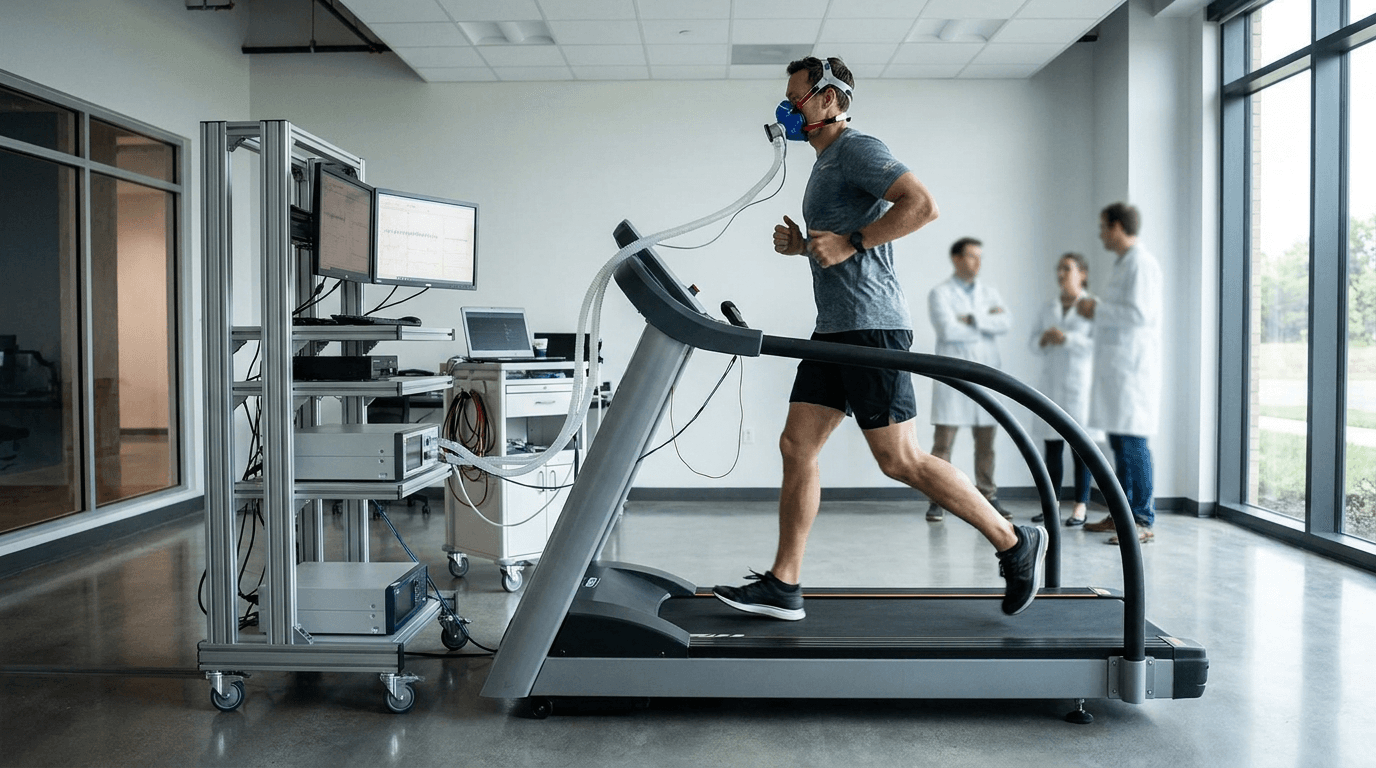
The term itself stands for "volume of oxygen, maximum." During a graded exercise test — typically on a treadmill or cycle ergometer — work intensity is progressively increased while expired air is analysed in real time. The point at which oxygen consumption plateaus despite increasing effort is your VO2 max, expressed in millilitres of oxygen per kilogram of bodyweight per minute (ml/kg/min).
A higher number means your body can deliver and use more oxygen per unit of time — fuelling muscles more efficiently, recovering faster between bouts of effort, and placing less strain on the cardiovascular system at any given workload. In practical terms, it is the difference between climbing stairs without thought and arriving at the top breathless.
What the Numbers Mean
Fitness categories vary by age and sex, but broad reference ranges for adults are widely used by clinicians and exercise physiologists:
- Low: Associated with the highest health risk; most sedentary adults fall here if untrained.
- Below average / Fair: Modest but meaningful improvement in risk profile compared with the lowest category.
- Average / Good: Consistent recreational exercise typically brings most people into this range.
- Excellent / Elite: Competitive endurance athletes; associated with the most favourable long-term outcomes.
The steepest gains in longevity-related risk reduction appear to occur in the transition from the lowest to the second-lowest category — meaning even moderate improvements carry real significance.
Why It Matters More After 40
VO2 max declines at roughly 10% per decade from around age 30, and the rate of decline can accelerate further with inactivity. This erosion is largely silent in early stages: you do not feel it at your desk, only on the stairs, then on the school run, then progressively everywhere. By the time the decline becomes disruptive to daily life, a significant reserve has already been lost.
The encouraging counter-narrative is that VO2 max responds to structured training at virtually any age. Consistently active adults in their 60s and 70s can maintain cardiorespiratory fitness profiles comparable to sedentary individuals decades younger. This plasticity means the trajectory is not fixed — it is, to a meaningful degree, a choice.
In the UAE context, where outdoor exercise is constrained by extreme heat for several months of the year, many adults accumulate prolonged periods of very low physical activity. This seasonal deconditioning can have a compounding effect over years if not deliberately addressed.
Estimate vs. True Measurement
Most modern smartwatches and fitness trackers provide a VO2 max estimate derived from algorithms that factor in heart rate, pace, and sometimes heart-rate variability. These estimates are useful for monitoring trends over time within the same device. However, they can diverge from laboratory-grade measurements by a clinically meaningful margin — sometimes more when fitness levels are at the extremes, when the user has an atypical physiology, or when the device has limited motion or heart-rate data to work with.
A proper gas-exchange assessment — using a metabolic analyser and a calibrated protocol — delivers a true VO2 max figure, along with additional clinically useful data:
- Ventilatory threshold (VT1 and VT2): The precise intensities at which your metabolism shifts — critical for accurate training zone prescription.
- Fat oxidation rate: How efficiently your body burns fat at different intensities, relevant for metabolic health and endurance performance.
- Cardiac efficiency: How hard your heart must work at submaximal efforts, a useful indicator of cardiovascular health trends.
This level of detail transforms the assessment from a curiosity into a genuinely actionable training and health blueprint. xlr8well offers this assessment as part of its at-home Clinical Longevity Programme, bringing clinical-grade testing to you rather than requiring a hospital or sports science laboratory visit.
Training VO2 Max: The Evidence-Based Approach
VO2 max is trainable, and the strategies that move it most reliably are well established in exercise physiology. The key is combining sufficient volume of low-intensity aerobic work with targeted high-intensity sessions.
Zone 2 Training: Building the Base
Zone 2 refers to steady-state aerobic exercise performed at a conversational pace — roughly 60–70% of maximum heart rate for most people. At this intensity, the body preferentially uses fat for fuel, mitochondrial density in muscle cells increases, and the cardiovascular system adapts structurally over time. Aiming for three to four sessions per week of 30–60 minutes each can meaningfully improve aerobic base capacity over 8–12 weeks.
High-Intensity Intervals: Pushing the Ceiling
One weekly session targeting true VO2 max intensity has strong support in the research literature. A commonly cited protocol is four minutes of hard effort (at approximately 85–95% maximum heart rate) followed by four minutes of active recovery, repeated four times. This format stresses the oxygen-delivery system enough to prompt upward adaptation without generating excessive fatigue when embedded in a broader training week.
Retest and Reassess
Progress that is not measured is difficult to sustain. Retesting every three to four months gives you objective confirmation of improvement — or an early signal that a training approach needs adjusting. It also re-anchors your training zones to your current fitness level, which shifts as you improve.
Who Should Prioritise a VO2 Max Assessment?
A formal assessment is particularly valuable for:
- Adults over 40 who want a clear baseline for longevity planning.
- Individuals with risk factors such as a family history of cardiovascular disease, type 2 diabetes, or metabolic syndrome.
- Anyone returning to exercise after a prolonged break, illness, or surgery.
- Recreational athletes looking to train more precisely rather than just harder.
- Executives and professionals managing chronic stress and sleep deficits who want an objective health metric.
If you have known cardiovascular conditions or have been advised to seek medical clearance before exercise testing, please consult a licensed doctor before undertaking a maximal fitness assessment.
Safety and Limitations
Maximal exercise testing is generally safe in healthy adults, but it does carry a small cardiovascular risk — which is why assessments should be conducted with appropriate screening, monitoring, and qualified supervision. Submaximal or estimated protocols may be more appropriate for individuals with certain health conditions.
It is also worth noting that VO2 max, while a powerful predictor, is one metric among many. Muscle strength, grip strength, metabolic markers, sleep quality, and psychological wellbeing all contribute to healthy longevity. A good assessment programme will contextualise VO2 max within a broader health picture rather than treating it in isolation.
For cardiac emergencies during exercise — chest pain, severe shortness of breath, loss of consciousness — call 999 immediately.
The Bottom Line
VO2 max is arguably the most information-dense single number in preventive health. It reflects decades of lifestyle habits, predicts future health outcomes with unusual reliability, and — crucially — can be improved at any age with the right training stimulus. In a city like Dubai, where the pace of life is fast and preventive healthcare is increasingly sophisticated, knowing your true number and building a protocol around it is one of the most evidence-informed investments you can make in your long-term health.
Your watch can keep guessing. With a proper assessment, you will know.